Saturday Jun 13, 2026
Saturday Jun 13, 2026
Saturday, 13 June 2026 05:06 - - {{hitsCtrl.values.hits}}
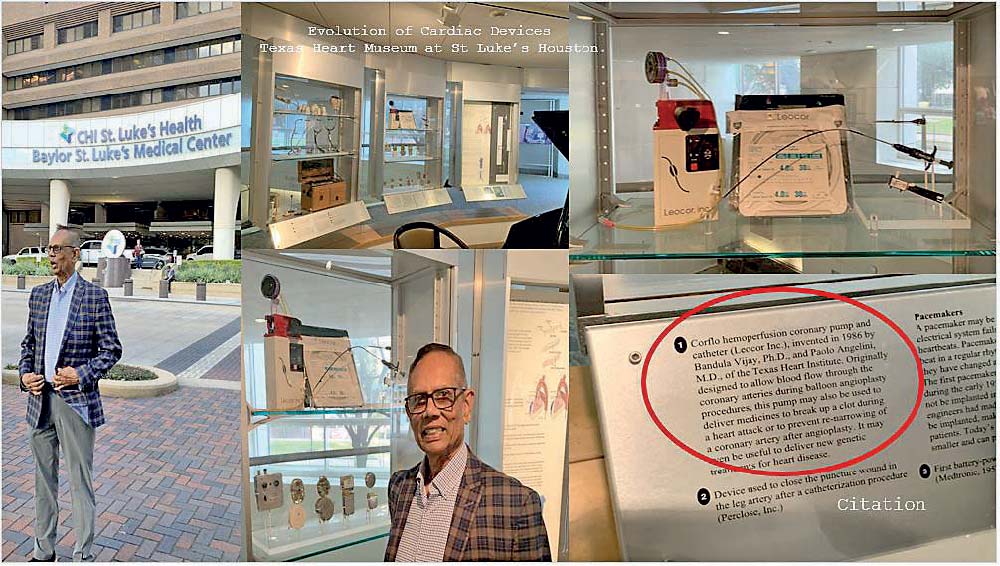
 What stands out in Dr. Wijay’s story is that he wakes up every day knowing that what he invented has changed many lives. Unveiling the balloon catheter system and the nested-loop vascular stent are his defining inventions, illustrating the impact one person’s focus and perseverance can have
 Dr. Bandula Wijay looked both happy and fulfilled as he recounted receiving a fruit basket in his hotel room during a knowledge-sharing visit to Colombo.
The head of hotel management, having learned who he is, sent him this cardio-friendly gift, thanking him for saving his life after a health scare that required a stent. Meanwhile, I read in the local daily press about a shortage of stents for heart patients in our healthcare facilities—painfully ironic. What stands out in Dr. Wijay’s story is that he wakes up every day knowing that what he invented has changed many lives. Unveiling the balloon catheter system and the nested-loop vascular stent are his defining inventions, illustrating the impact one person’s focus and perseverance can have.
Meeting Dr. Wijay as a Fulbright scholar in 2025 allowed me to see firsthand the breadth of his contribution as an inventor, engineer, educator, innovator and diplomat. His story and the paths he explores daily exemplify the value of purpose-driven innovation.
From his early work at CISIR (now ITI), Dr. Wijay’s drive for research-led development was evident. Rather than focusing on missed opportunities in Sri Lanka, I aim to highlight what enabled his success in the United States, hoping this can be a lesson for Sri Lanka. A conversation with him yields a flood of advice on what can change in Sri Lanka and what should be changed in Sri Lanka – no holds barred.
Approaching his 80th year, he remains energetically devoted to his work—often on several heart-related projects at once. He is straightforward about his luck, but ultimately his story underscores how pursuing purpose with focus in the right environment can create real impact.
He arrived in the USA on a Fulbright award and completed his PhD in Chemical Engineering at the University of Southern California. He also completed two master’s degrees in chemical and mechanical engineering before pursuing his PhD.
He has understood the importance of entrepreneurship and the start-up mentality early in his PhD journey. His purpose had not been based on completing the PhD, securing a safe salaried position, consolidating stability, and being part of something.
Of course, in the USA, you do not hear marching in the streets, asking for Government positions and ticking the box for a secure pension. You venture out, and there is always the spirit of enterprise, and the system is more than willing to accommodate such spirits. There is no such thing as audit phobia, nor is it the fear of failure. Young Bandula embraced the environment, and the innovation journey is still going on. He had gone on to study various modules that are necessary to support his ideas when needed, and the system supports that, too.
Journey of innovation
His innovation journey began where many American success stories do: the garage. Equipped with machines, shelves filled with prototypes, and storage boxes containing various gadgets, this was the birthplace of many of his ideas. Next to it, his office displays the journey—companies founded, products created, and over 30 patents —inspired in part by Peter Drucker’s article on innovation; the article, too, finds its place on the wall, suitably framed. Now managing his fifth company, he continues to build on that foundation.
In the early 1980s, Dr. Bandula Wijay made a landmark contribution to interventional cardiology by inventing the Active Perfusion System (US Patent 5,066,282) — a breakthrough that fundamentally transformed the safety and comfort of coronary balloon angioplasty. At the time, balloon inflation within a coronary artery inevitably cut off blood flow to the heart muscle beyond the blockage, causing patients to suffer severe chest pain and alarming electrocardiographic changes, making the procedure both distressing and hazardous.
Dr. Wijay’s ingenious solution was to harness the patient’s own oxygenated blood, drawing it from the renal vein and delivering it continuously through the angioplasty catheter’s guidewire lumen to the distal myocardium using a disposable pump — ensuring that the heart muscle remained perfused throughout the procedure.
The impact was immediate and profound: patients were spared the agonising ischemic pain that had previously been considered unavoidable, and the procedure became significantly safer. Perhaps most remarkably, a clinical study of approximately 50 patients revealed a substantially lower rate of restenosis — the stubborn re-narrowing of treated arteries that had long been one of interventional cardiology’s most vexing and unresolved challenges. When I listened to this story, I saw that he is especially proud of this development.
Dr. Wijay’s spirit of innovation did not stop there; I would now like to call him a serial inventor. He went on to invent the Nested Loop Stent (US Patent 6,340,366), another breakthrough device that addressed one of the most pressing mechanical challenges in coronary intervention. The nested loop design achieved a rare and highly sought-after combination of exceptional radial strength — necessary to hold open a diseased artery against the forces that would cause it to recoil — and the critical flexibility required to navigate and deliver the stent through the complex, often tortuous anatomy of the coronary arteries.
This elegant engineering solution opened the door to treating lesions that had previously been difficult or impossible to reach safely. Together, these two inventions place Dr. Wijay among the most consequential scientist/engineer-innovators in the history of interventional cardiology, with contributions that have directly improved patient outcomes and helped shape the technological landscape of the specialty for generations.
His participation at the STS Forum 2016 in Colombo—a key event for Sri Lanka’s scientific community—rekindled his exchanges with Sri Lanka. He was appointed Ambassador – Science, Technology, and Innovation of Sri Lanka and received Vidya Jothi, the highest honour.
Today, his innovations are supported by research assistants in Sri Lanka, a way of giving back to the country. These engagements are a huge mentoring opportunity for many aspiring researchers or inventors.
He ensured I saw the Houston innovation ecosystem firsthand. The message: learn as much as possible to replicate or initiate it at home.
Houston’s medical innovation system is claimed to be the world’s largest, and especially with the heart, Houston appeared to have orchestrated almost everything – chronicled well in the Houston Heart Museum (more formally known as the Dr. Denton Cooley Museum), minus only the South African event of Christiaan Barnard, the cardiac surgeon who carried out the first human-to-human heart transplant. Dr. Bandula Wijay also figures in the museum. All innovation elements are nearby. Each university has clear commercialisation paths with set guidelines. From the start, he encouraged me to study the Oshman Engineering Design Kitchen at Rice University. I participated in an entire student design cycle and am now trying to emulate it in Sri Lanka.
He has established a scholarship scheme for Sri Lankan students and has supported 52 medical graduates from various faculties, as well as two other graduates. He is proud that some scholarship recipients are now thriving in the Houston Medical System. He regrets that his advice isn’t always followed in Sri Lanka; he actively engages with everyone passing through Texas, sharing his approach. Then he watches their follow-through from a distance, and I am sure that I, too, will be under scrutiny to ensure I did not just receive a few joy rides and meals in Houston! In the USA, ideas are naturally translated into action, and such initiatives are recognised.
It is instructive to see him in action. Always, an idea is vetted through conversations with those who have an established presence in the domain. The conversations appear to occur quite frequently, and the willingness of specialists to schedule appointments and engage in discussions is a cultural element, as I observed. He is quite willing to discuss his ideas, which reminds me of the saying that feedback is the breakfast of champions.
The strategy he has followed is to convert ideas into proof of concept, then scale within a company established for that purpose, and sell the company. That you need time and energy to go through the process is also clear. It is at a particular level of activity that you start getting attention. However, after the first sale, you are part of the league, and the journey is eased somewhat, but it can never be guaranteed. He has completed about three company sales stemming from his findings. It is part of these profits that he is sending to Sri Lanka in support of young talent – supporting our national pulse.




