Wednesday Aug 26, 2026
Wednesday Aug 26, 2026
Friday, 10 July 2026 00:21 - - {{hitsCtrl.values.hits}}
 As I scanned the Earthset pictures from the successful Artemis II mission launched from the Kennedy Space Centre, alongside the story of Rise, the plush toy designed by an 8-year-old Ye, my mind went back to my short stay as a Fulbright Visiting Scholar at Rice University. As a strategic initiative, Rice University has donated land to establish the Johnson Space Centre and has initiated the first Space Science and Technology Department at a university in the USA. It is rumoured that the 1000 Acre land was given for $20. The connection today between NASA and Rice University is, in my view, a cosmic bond. This relationship enabled Houston to be the Space City of the United States. In the United States, universities are a hotbed of economic activity, and Rice is a leader. Universities take pride in knowledge generation and learning, from policy formulation to economic growth advocacy. I remember reading the student newsletter at Rice – the Rice Thresher celebrating the most recent state activity that Rice has strongly advocated – The Dementia Prevention and Brain Research Institute of Texas, a $ 3 billion investment. ‘Rice Thresher’ led me to explore why the student paper has been named as such. Texas is a key state for paddy cultivation in the United States, and the Texas economy benefits by $500 million from growing and processing paddy. Therein lies my lesson, multiple lessons in fact.
Big mismatch
Back at home, I am used to hearing the role of a university described solely as ensuring employable graduates, and to the oft-stated perception that this is not realised – the big mismatch between what is needed and what is produced. Measure the pulse of society: they see institutions as hot spots of unproductive issues and, increasingly, as institutions wasting taxpayers' money. The basic expectation of the state is to look after the institution, providing funds from the state coffers and ensuring staff salaries. Sadly, the State does not consider universities' output in the development process at all, and the university, too, has adjusted itself to this negative working model. This is the home truth I found so refreshingly different at Rice, and the realisation of how important that difference is to society and the economy at large. Now, Rice University is a Private University, yet its mindset and mandate remain relevant and focused on leading change. Today, being globally present and getting engaged is the way of working. ‘Momentous,’ the Rice Strategic Plan is a lesson to me.
The time available to me at Rice was not much; I had to settle for 75 days, to be precise. Receiving a Fulbright is an opportunity, and it is not guaranteed upon application. Having succeeded, I was determined to soak up lessons in all formats, as I am a strong believer that universities should be pioneering institutions and, when well directed, game-changers.
One expectation of the Fulbright is what you give and what the US gets back in terms of taxpayer money invested in supporting someone from another country at a US institution. I hope I met both requirements. Here I am being responsible for the first part – writing about what Rice taught me through practice.
Pioneering the nanotechnology revolution
The research environment is what really stood out to me. No matter how many students you graduate with excellent teaching and by reciting known knowledge from elsewhere, the university will not be a high-value institution nor a beacon for the economy and society if research is absent. In the US, the thrust is on ensuring that the university is a research university, and that is the most important differentiator. Rice has now made its mark in research by pioneering the nanotechnology revolution. It is interesting to wonder what made the journey to Rice by William Kroto from Exeter University to meet and work with Smalley and Curley. Kroto, the space-chemistry explorer, was aware that Smalley and Curl were using lasers to generate high-temperature plasma in their Rice labs. He collaborated to test one of his hypotheses, and the discovery of buckyball (Fullerene) led to the Nobel Prize for all three and the creation of a brand-new material space for more creative exploration. The world was placed on a different trajectory from that research. 
The university was open to collaboration, and its work was known in faraway places. A researcher alone cannot succeed, and in today’s climate, the lone warrior working in isolation, holed up in a room, doing and going great is wishful thinking. The ecosystem is of utmost importance, and Rice is constantly pushing this boundary. I was fortunate to be present when the 1985-2025 celebration (C60 at 40) of nanoscience happened at Rice. The global nanotech researcher convergence at Rice for the celebratory event and the discussions on the past and the future were inspiring. This is not just a one-off event for Rice. The building I spent my time at Rice had the following plaque on its wall, showing that invention and discovery are things that Rice takes in its stride. I would say that what characterises research universities in the USA is the number of novel ideas and amazing progress that pours out of their portals. The companies that resulted from spinoffs and spinouts, taking the intangibles, then go on to make a tangible difference.
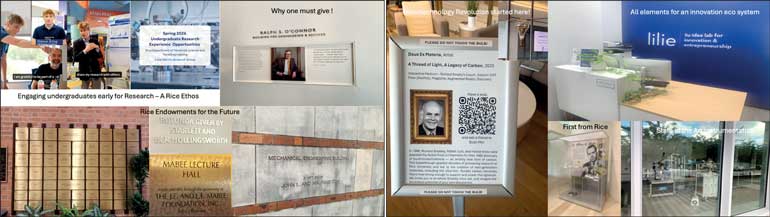
I noted the encouragement given to early-stage undergraduates to engage in ongoing research. The presence of a 2nd-semester chem eng undergraduate immersed in a top-tier research group that shared resources equally left a deep impression. Upon my return, I was amazed to see Rice on LinkedIn showcasing the same undergraduate for his pioneering research work on lithium battery recycling. Opening research to all levels and running well-resourced research teams in creative spaces is a surefire recipe for success, as Martin has aptly shown. It is said that 80% of Rice Owls engage in research at the undergraduate level. I witnessed undergraduates from all disciplines converging at OEDK (Oshman Engineering Design Kitchen) to work on industry problems, funded by industry. Failure is not an option made famous by Apollo 13 Mission Control at Johnson, applies to all those who take on a problem. There is no rote learning, no regurgitating of definitions and set answers. I sat through a few lectures at different levels, and every 55 minutes, they went from basics to applications in a content-rich manner.
Support for research
Support for research at Rice does not stop at the bench scale and papers. The complete value chain for bringing ideas to market and valorising research is present, as research without application will not bear fruit. Rice guidelines on disclosures and patenting, support from a professional Tech Transfer Office, Incubation space for internal students (Liu Idea Lab for Innovation and Entrepreneurship), and space for collaborative workspaces with external partners (ION district) are all available in the Rice innovation ecosystem. The emphasis on transformative challenges is where one always spends energy, as evidenced by listening to the Moonshot Caption of X (initially Google X), Astro Teller, who has strong ties to Rice. The imaginative projects – named as moonshot projects- going through the mill at X were sufficient to indicate that the next level of competitiveness was always taking place with such enterprising endeavors. There appears to be strong, seamless connectivity with university students. It is this mutual interdependence that breeds success. The last thing you hear is poor industry-university collaboration! 
Another interesting fact noted was the extent of support Rice was continuously receiving through endowments and grants. Wherever you go, you will always see a plaque celebrating a donor. Yes, the university itself had been an endowment – explaining why it is called Rice University. The Rice endowment fund is one of the richest among US universities today, valued at around $ 8 billion. The most significant in that part of the United States. The founders had the idea of ensuring an institute with a unique visibility housed in noble architecture. As you approach Rice, you see that. It is on record the statement of Edgar Lovett, the desire to establish on the campus a group of buildings conspicuous alike for their beauty and for their utility, which should stand not only as a worthy monument to the founder’s philanthropy, but also as a distinct contribution to the architecture of the country. Reading this, as well as experiencing it, I remembered Ivor Jennings's objective when he established the University of Peradeniya. He had expressed the very same intentions, but alas, in our case, that was not to be; cost-benefit and least-cost allocations only satisfied utility. The most beautiful campus of that size in the world, as Ivor envisaged, lost out, with only the natural endowments remaining. A place of scholarship should be able to nurture creativity, and that is not possible when you purchase a chair solely for its basic function and treat almost everything else with a similar mindset. Such places are spaces of torture rather than spaces of creativity. When one thinks, perhaps the results we see are then not surprising, as they must be correlated to the suffering.
With all these pluses, Rice still has some distance to cover when it comes to ranking within the US, which demonstrates how universities aggressively follow research-led growth. Even with pioneering landmark developments and with constant engagements, one senses how much one must do to stay on top. Rice recently rose considerably in the global QS rankings, placing 122nd globally and 29th in the US. Rice, I see, is well set to lift off in Houston.
(The author is Senior Professor in Chemical and Process Engineering, Department of Chemical and Process Engineering, Faculty of Engineering, University of Moratuwa)




