Monday Apr 06, 2026
Monday Apr 06, 2026
Monday, 6 April 2026 03:15 - - {{hitsCtrl.values.hits}}
Picture courtesy: Radio Veritas Asia
 Leadership is not about positions and titles, but about decisions and actions. It is essentially a mindset. We look at the leaders at the top but not the “leaders at the tap”
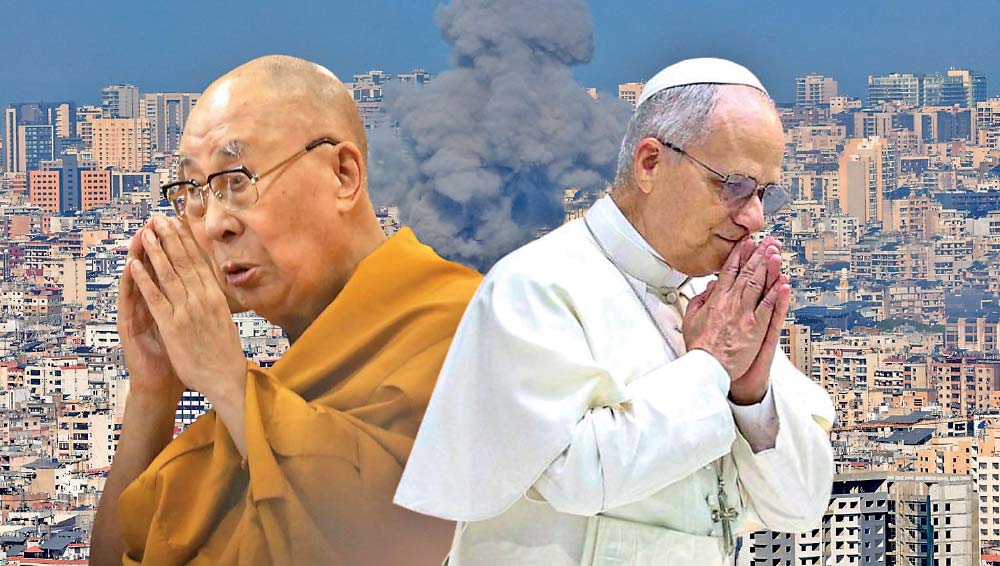
 Yesterday was Easter Sunday, associated with the resurrection of a revered leader. With the turbulent times we experience in global, regional, and local fronts, leadership is once again in the limelight. The “war mongers” and “peace makers” are both being showcased in social media. It is an opportune time to explore the endeavours of enlightened leaders.
Overview
Leadership is not about positions and titles, but about decisions and actions. It is essentially a mindset. We look at the leaders at the top but not the “leaders at the tap.” An enlightened leader rises above the rest in being conscious, compassionate, and collectivistic with an authentic purpose-driven nature. It is not only great religious leaders such as Buddha, Jesus Christ, or Prophet Mohamed but many others emerging from socio -cultural and religio-political fabrics to “produce value by practicing values.”
As reported by Reuters, Pope Leo spoke on the phone with Israeli President Isaac Herzog last Friday and urged him to "reopen all paths of dialogue" to end the Iran war. The pope, who has emerged as a sharp critic of the regional conflict, also urged Herzog to protect civilians and promote respect for international and humanitarian law, the Vatican added.
"I'm told that President Trump has recently stated that he would like to end the war,'' the U.S.-born Pope said, according to the National Catholic Reporter. "I hope that he's looking for an off-ramp.'' "Hopefully he's looking for a way to decrease the amount of violence, of bombing, which would be a significant contribution to removing the hatred that's being created, that's increasing constantly in the Middle East and elsewhere."
It is interesting to note that the Pope Leo called on all world leaders to return to dialogue and look for "ways to reduce the amount of violence,'' so that "peace, especially at Easter, might reign in our hearts.''
Reality and responses
We witness that the political leaders on all sides of the current middle-eastern conflict attempt to use religion to justify their actions. Some officials have invoked their Christian faith to cast the war as a Christian nation trying to vanquish its foes with military might. The vice versa is also seen with utterances of rivalry and revenge.
Another global leader has expressed sincere sentiments in support of peace. The Dalai Lama recently issued a public statement in which he commended a recent appeal for peace made by Pope Leo on Palm Sunday. The Tibetan spiritual leader highlighted the necessity for dialogue, diplomacy, and decency as the sure sustainable path for lasting peace.
“Indeed, whether we look to Christianity, Buddhism, Islam, Hinduism, Judaism or any of the world’s great spiritual traditions, the message is fundamentally the same: love, compassion, tolerance, and self-discipline,” the Dalai Lama remarked. “Violence finds no true home in any of these teachings. History has shown us time and again that violence only begets more violence and is never a lasting foundation for peace.” As he further commented, “an enduring resolution to conflict, including the ones we see in the Middle East or between Russia and Ukraine, must be rooted in dialogue, diplomacy and mutual respect—approached with the understanding that, at the deepest level, we are all brothers and sisters.”
It is encouraging to see some of the European political leaders are actively pushing for de-escalation and a ceasefire in the expanding Middle East conflict. Opponents of the war emphasise diplomacy, concern for regional stability, and economic consequences. Several countries including France, Norway, Sweden, and Spain, have questioned the legal basis for expanded military actions in the region.
As anticipated, UN Secretary-General António Guterres warned that the Middle East is on the brink of a wider, catastrophic war, with the conflict entering its second month and escalating regional instability. He urged an immediate halt to the hostilities, specifically calling for an end to attacks by the US and Israel on Iran and vice-versa. Whether the multi-faceted role expected of the UN in a conflict of this nature, inclusive of peacekeeping, humanitarian aid, and diplomatic mediation to prevent wider escalation is played effectively, is a big question mark.
Enlightened business leaders in action
As we often hear, "it is better to light a candle than to curse the darkness". Who are the guiding lights in the business domain? Let me share three such cases, with all due respect to many such others whom we know or do not know. They are Akio Morita, Ratan Tata, and Warren Buffet.
Morita the motivator
Akio Morita was a real motivator for his Japanese counterparts in promoting the need to have high quality affordable products. As a co-founder of Sony, was instrumental in changing the international perception of Japanese goods from "cheap" to high-quality. He was a global visionary who emphasised innovation and international partnership, making Sony a global leader in electronics. His insights, largely featured in his book Made in Japan, reflect his focus on fostering a productive, happy, and innovative workforce.
He acknowledged the devastation of second world war and the necessity of rebuilding Japan through innovative, high-quality manufacturing, often referencing his goal to change the world's perception of Japanese products. “If we do our best and make efforts, a peaceful and great future will become ours without fail", said he.
Tata the trailblazer
Ratan Tata was indeed a trailblazer in taking Indian firms to global level. He transformed Tata Group from a disparate collection of Indian companies into a global powerhouse while maintaining a profound commitment to ethics, philanthropy, and human-centric values. His leadership style, often described as humble, visionary, and compassionate, prioritised long-term sustainability over quick profits. He demonstrated that business success can coexist with high moral standards, setting a "gold standard" for corporate governance in India.
"Ups and downs in life are very important to keep us going, because a straight line, even in an ECG, means we are not alive", so said Tata. Following the terror attacks on the Taj Mahal Palace Hotel, in Mumbai, in 2011, Tata personally met with the families of every employee killed or wounded, ensuring their lifelong financial support. He often prioritised the physical well-being of his staff, such as ordering robotic automation to eliminate back-breaking labour for workers at his plants.
As we often hear, "it is better to light a candle than to curse the darkness". Who are the guiding lights in the business domain? Let me share three such cases, with all due respect to many such others whom we know or do not know. They are Akio Morita, Ratan Tata, and Warren Buffet
Warren the warrior
Warren Buffett is a warrior in wealth creation. He, with Berkshire Hathaway fame, is widely regarded for his unwavering ethical compass, long-term focus, and dedication to stewardship over personal spotlight. He has transformed corporate leadership by prioritising character, decentralised trust, and philanthropy. As he often said, “it takes 20 years to build a reputation and five minutes to ruin it". Referring to war, his famous advice is simple. “The last thing you'd want to do is hold money during a war". History shows that stocks generally outperform cash during chaotic, inflationary periods like war.
Warren Buffett's uniqueness lies in his unwavering commitment to value investing, extreme patience, and a "circle of competence" approach that favors simple, understandable businesses. His legendary calm during market volatility, combined with a modest, long-term perspective and immense capital, allows him to act rationally when others panic, separating him from short-term speculators.
Having discussed the above three, let us get back to the business of war. As reported by Al Jazeera, a one-month war in the Middle East involving Iran and Arab states is projected to cost the Arab region up to US$ 194 billion in lost GDP, causing 3.7 million jobs to be lost and driving millions into poverty. The conflict has significantly impacted global markets, driving up Brent crude oil prices and increasing regional shipping costs.
Enlightened leadership in Islam is defined by service (Hadith), justice, accountability, and the emulation of prophetic character. In Hinduism, enlightened leadership within the Bhagavad Gita, emphasises self-mastery, selfless service (Nishkama Karma), and acting for the collective good (Loka-sangraha) rather than personal gain. The challenge is to put these cherished concepts into concrete action
Martin Luther King and “No Kings movement”
“Our scientific power has outrun our spiritual power. We have guided missiles and misguided men.” So said Martin Luther King Jr., one of the enlightened leaders of yesteryear, who promoted human dignity. This is in stark contrast to some democratically elected leaders who want to appear as kings.
He was a Christian minister and social activist who led the civil rights movement in the United States from the mid-1950s until his death by assassination in 1968. His “I Have a Dream” speech, Nobel Peace Prize lecture and “Letter from a Birmingham Jail” are among the most revered orations and writings in the English language. His accomplishments are now taught to American children of all races, and his teachings are studied by scholars and students worldwide. He is memorialised in hundreds of statues, parks, streets, squares, churches, and other public facilities around the world as a leader whose teachings are increasingly-relevant to the progress of humankind.
The tide in the USA has turned now to “No Kings". It has been a massive, decentralised, nonviolent protest movement in the U.S. and internationally targeting the current administration, protesting against perceived authoritarianism, executive overreach, and policies regarding immigration and the military. Led by the No Kings Coalition, it advocates for democracy and has drawn millions to protests in early 2026. Its core slogan is "America has no kings," emphasising that power belongs to the people, not a monarch-like leader.
Way forward
It is interesting to observe the presence and absence of enlightened leaders in religious, political, business and many other spheres of life. Enlightened leadership in Islam is defined by service (Hadith), justice, accountability, and the emulation of prophetic character. In Hinduism, enlightened leadership within the Bhagavad Gita, emphasises self-mastery, selfless service (Nishkama Karma), and acting for the collective good (Loka-sangraha) rather than personal gain. The challenge is to put these cherished concepts into concrete action.
Like the turbulent world, Mother Lanka is in much need of enlightened leaders. In shedding aside the petty issues, and side-stepping the religious and racial land-mines, we need solidarity in moving ahead as a “non-aligned” sovereign nation with pride.
(The author, a Senior Professor in Management, and an Independent Non-executive Director, can be reached at [email protected], [email protected] or www.ajanthadharmasiri.info.)



