Friday Mar 13, 2026
Friday Mar 13, 2026
Monday, 9 March 2026 04:02 - - {{hitsCtrl.values.hits}}
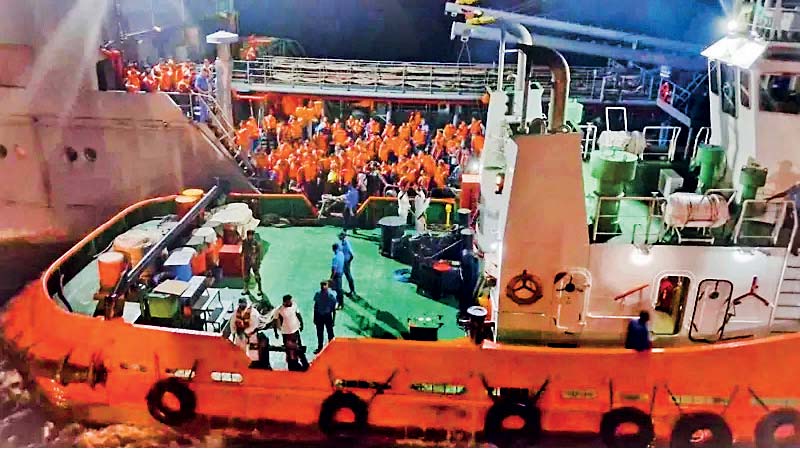
Some 208 members of the Irins Bushehr have been evacuated (Picture courtesy BBC)
 Humanity has come to the end of an era that cannot be governed according to the ideas and institutions of the previous century. The magnitude and complexity of the problems confronting us today confirm the need for a radical shift to a new paradigm for global peace and development that transcends conventional thinking. The increasingly tense global landscape with justifying violence against violence is far from the much needed humane approach
 I am delighted to pen my 500th column of “Humane Results”. It was a journey spanning over 15 years through turbulence. The current Middle East crisis that dragged Sri Lanka also into the hotspot is an interesting challenge of balancing humanity and geo-politics. Today’s column reflects on managing humanity amidst damaging turbulence.
Overview
As BBC reported, it was last Thursday that the Iris Bushehr requested permission from Sri Lanka to come into port, citing engine issues. The Sri Lankan president eventually allowed it to dock at the port of Trincomalee, though the vessel was near the country's main commercial port in Colombo. There was a risk of the country's maritime industry being "adversely affected", should the ship have docked in Colombo. As it was further stated, the crew members of the Irins Bushehr, including 53 officers, 84 cadet officers, 48 senior sailors and 23 sailors, will be brought to Colombo.
Managing humanity as a leader is a tough call in times of geo-political turbulence. Such geopolitical turbulences are typically driven by wars, rivalries, atrocities and retaliations and instabilities. It appears that there is an accelerating shift towards a multipolar world with fragmented trade, regionalised supply chains, and high-stakes protectionism. Such an environment increases risks to global shipping routes, raises trade barriers, and drives up political challenges across many countries. Sri Lanka, given its geo-political realities with a barrage of economic challenges is no exception.
Turbulences galore
I read with interest what Garry Jacobs and Ketan Patel, leadership thinkers, wrote to Cadmus Journal. “We live in turbulent times characterised by rising levels of uncertainty, doubt, distrust, and insecurity. Rising insecurity is leading to the polarisation of societies, social unrest, extremism, violence, war and geopolitical instability. These characteristics reflect symptoms of deeper underlying structural and systemic causes rather than isolated events. The world is in the midst of a multidimensional global crisis encompassing political, economic, technological, social, cultural and environmental components”.
As they further observe, what has evolved over a period of time is manifested as the rapid globalisation of society, accelerated pace of social change, rising levels of inequality and financial instability, competitive economic nationalism, and a scramble for global leadership and effective policies to fill the vacuum. In a “glocal” world, Sri Lanka has to face such realities with needed wisdom.
What happened in Gaza is another case in point. With hundreds of thousands facing extreme hunger and famine, and children suffering from severe malnutrition, urgent action is still needed in Gaza. A ceasefire agreement was reached in October 2025, allowing the safe return of hostages and an increase of aid into Gaza. That critical move offered a crucial moment of hope, and a fragile chance to start healing. It highlighted the heightened challenges of humanity.
Humanity at cross-roads
Meeting members of the Diplomatic Corps, Pope Leo XIV warned that human rights and freedoms are under strain as diplomacy gives way to the logic of power and war. According to Vatican News, warning that “war is back in vogue” and that peace is increasingly sought through force rather than justice, Pope Leo XIV issued a strong appeal for humility, dialogue, and a renewed commitment to multilateralism. “The principle established after the Second World War, which prohibited nations from using force to violate the borders of others, has been completely undermined,” he said, warning that such a mindset gravely threatens the rule of law itself.
It reminds me of what his worthy predecessor, Pope Francis said. “Every human life has an inestimable value”. “The life that we are called to protect and defend is not an abstract concept but is always manifested in a flesh and blood person: the newly-conceived child, a poor marginalised person, a sick person suffering from discouragement or a terminal illness, a person who has lost their job and cannot find work, a refugee or ghettoised migrant…life manifests itself concretely in people.”
Humanity has come to the end of an era that cannot be governed according to the ideas and institutions of the previous century. The magnitude and complexity of the problems confronting us today confirm the need for a radical shift to a new paradigm for global peace and development that transcends conventional thinking. The increasingly tense global landscape with justifying violence against violence is far from the much needed humane approach.
With hundreds of thousands facing extreme hunger and famine, and children suffering from severe malnutrition, urgent action is still needed in Gaza
Humane results to the forefront
What I wrote in my very first column of “humane Results” is still relevant here. The term humane typically means caring, kind, gentle, compassionate, civilised and kind. These definitions all revolve around people. Results, on the other hand, are to do with achievement. It could be goals, objectives, targets and measures. When we combine the two terms, the emerging idea is the need to achieve results through people.
Managing people on all fronts has its promises and pitfalls. Humans have potential and unleashing it has to happen in the organisational setting in order to obtain the desired results. That is the promise. The other side of the coin is the fact that humans are neither rational nor irrational; they are natural, or “a-rational”, if I am to coin a term. There is a high degree of unpredictability in human behavior. There can be swinging between emotional extremes, be it glad, sad or mad . Managing people is an art and science in that respect. It needs an appeal to the head, with structure, direction and control. That is being scientific. It also needs an appeal to the heart, with purpose, passion and positivity. That is being artistic. Hence, a carefully planned set of “head” and “heart” strategies should be on offer. Such aspects are not only applicable at organisational level but at national and international levels as well.
It reminds me of what Lao Tsu said a long time ago. If you want to plan for one year, plant corn. If you want to plan for three years, plant a tree. If you want to plan for ten years, plant people. People development is a long term affair. You cannot rush sunshine. There was a European CEO whom I knew, who used to yell at his senior colleagues, “Where is my EBITDA?” EBITDA stands for Earnings before interests, taxes, depreciation and amortisation. Surely, he should have been interested in that, but the issue was that he was only interested in that. People's development went down the drain. Same approach can be seen at political fronts with opportunistic leaders who believe in a “might is right” approach.
What Seneca, a Roman philosopher said, makes a profound sense here. “Dum inter homines sumus, colamus humanitatem” meaning “as long as we are among humans, let us be humane”. Do we see such behaviours among the leaders who are central to the current geo-political turbulence? At least, some authentic attempts to resolve and to de-escalate are also not seen much. Do we see the United Nations (UN) acting according to its mandate? Having been established in 1945 to maintain international peace and security, develop friendly relations among nations, and promote social progress, better living standards, and human rights, it should act as a central hub for international cooperation to solve economic, social, cultural, and humanitarian challenges. Whether it is happening at a satisfactory level for the upholding of humanity is a question mark.
Managing humanity as a leader is a tough call in times of geo-political turbulence
From macro to micro initiatives
It is better to light a candle than to curse the darkness. Whilst being vigilant at world events, we can do something at our ends in managing humanity. Rasmus Hougaard and Jacqueline Carter writing to Harvard Business Review advise us to stretch people to see their potential. “We all want to perform and be appreciated. A good leader values who we are today but also challenges us to stretch ourselves and do better to realise more of our true potential. This is not easy. When someone is already doing well, pushing them to do better can be discouraging and demotivating. But leadership is not about trying to please people and make them feel content and at ease. Leadership is about supporting people by shining a light on things they may not want to face. Instead of shying away from these uncomfortable conversations, try to view your role to stretch people as an indication of true care for them.”
As they further observe, “when we practice wise compassion by bringing more of our humanity to our leadership, we can create a culture in which others increase their focus on real human connections. As leaders, we should never underestimate the impact we have on people”. We have the power to control their livelihood. We have power over the work they do. And we have power over how they feel treated. This is a huge responsibility. This makes it of the utmost importance to do the hard work of leadership in a human way, so that we can be more successful in positively impacting people’s work experience, their sense of commitment, and their job performance.
Way forward
"My humanity is bound up in yours, for we can only be human together”, said Desmond Tutu. Being human and producing “humane results” is increasingly challenged with the geo-political turbulence linked to socio-economic crises. "The bond of our common humanity is stronger than the divisiveness of our fears and prejudices." That is what Jimmy Carter opined.
We in South Asia have to grapple with regional realities as well. As I wrote in my very first column, it is a “humanly rich” region, yet abundant with poverty, despite some of the best brains. Being human and upholding humanity cannot be compromised with any callous political motives. Despite all odds, I still find consolation in what revered religious text Dhammapada advocates. "Hatred is never appeased by hatred in this world; by non-hatred alone is hatred appeased".
(The author, a Senior Professor in Management, and an Independent Non-executive Director, can be reached at [email protected], [email protected] or www.ajanthadharmasiri.info.)




