Thursday Jul 02, 2026
Thursday Jul 02, 2026
Monday, 27 April 2026 00:22 - - {{hitsCtrl.values.hits}}
 Artificial Intelligence (AI) is all around us. Technology is making massive advances for both construction as well as destruction. In such a context, I enjoyed reading an “old but gold” book by Erich Fromm with an apt title “The Revolution of Hope.” The tag line shows us the essence of his endeavour “towards a humanised technology.” Today’s column reflects on its resounding insights relevant to a world ravaged by technology warfare with wide implications.
Overview
Erich Fromm, famous for his critical perspectives on many human advancements was a German – American scholar. He is hailed as a social psychologist and psychoanalyst, who was associated with the Frankfurt School of critical theory. His work challenged the theories of Sigmund Freud and brought psychoanalysis to bear on sociological and political questions. His work spanned at least five decades inclusive of the widely read books such as The Art of Loving (1956) and Escape from Freedom (1941), with a recurrent theme of upholding humanity.
“Reason flows from the blending of rational thought and feeling. If the two functions are torn apart, thinking deteriorates into schizoid intellectual activity and feeling deteriorates into neurotic life-damaging passions,” opined he. The Revolution of Hope, first published in 1968, contains his treasured thoughts elaborating the above further.
In his discussion of hope, Fromm asserts fluidly the need to be an interactive social being rather than an isolated individual. What he encountered in his time and age, is ironically relevant even today, as we witness the “technology addiction” of some, leading them towards self-centeredness and loneliness.
Hope in focus
“Hope is paradoxical. It is neither passive waiting nor is it unrealistic forcing of circumstances that cannot occur…. To hope means to be ready at every moment for that which is not yet born, and yet not become desperate if there is no birth in our lifetime. There is no sense in hoping for that which already exists or for that which cannot be. Those whose hope is weak settle down for comfort or for violence; those whose hope is strong see and cherish all signs of new life and are ready every moment to help the birth of that which is ready to be born.” The way Fromm elaborates hope with much depth and breadth is insightful.
According to Erich Fromm, hope is a positive and productive orientation towards an uncertain future. It gives a sense of meaning for individuals and institutions alike in moving beyond stagnation and frustration. It is an illuminating ray for many human lives embroiled in life crises. It is interesting to see how Fromm combines hope with the interrelated concepts of faith, fortitude, and fearlessness.
According to Fromm, faith is inseparable from hope. “Faith is the conviction about the not yet proven, the knowledge of the real possibility, the awareness of pregnancy. Faith is rational when it refers to the knowledge of the real yet unborn… We need no faith in that which is scientifically predictable, nor can there be faith in that which is impossible. Faith is based on our experience of living, of transforming ourselves. Faith that others can change is the outcome of the experience that I can change.”
 Such an awareness of faith opens a path for envisioning a future with a positive mindset. This is good news for many, even today, who are frustrated with failures. Ample evidence can be found from those who moved either from “rags to riches” or “imagination to implementation.” It resonates well with an often-heard adage that the future belongs to those who created it.
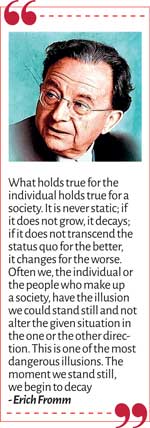
It is interesting to note how Fromm differentiates development from decay pertaining to human society. “What holds true for the individual holds true for a society. It is never static; if it does not grow, it decays; if it does not transcend the status quo for the better, it changes for the worse. Often we, the individual or the people who make up a society, have the illusion we could stand still and not alter the given situation in the one or the other direction. This is one of the most dangerous illusions. The moment we stand still, we begin to decay.”
According to Fromm, hope and faith are sustained through fortitude (or courage) with its associated fearlessness. As he describes, “fortitude is the capacity to resist the temptation to compromise hope and faith by transforming them.” Such a behaviour may result in “emptying oneself from greed” in moving towards a more holistic view and more humane actions.
“The person who has overcome greed does not cling to any idol or anything and hence has nothing to lose: he is rich because he is empty, he is strong because he is not the slave of his desires…. If he has moved toward this goal without having arrived, his fearlessness will also not be complete. But anyone who tries to move toward the state of being fully himself knows that whenever a new step toward fearlessness is made, a sense of strength and joy is awakened that is unmistakable. He feels as if a new phase of life has begun…..” Much to mull over about the way Fromm shared.
Being versus nothing
Fromm highlights an ongoing tension of man which he called “the dialectical tension between being and nothing.” It relates to the reality of existence, with many forms of associated challenges such as the material versus the ideal, the current versus the potential. According to him, the dynamism arising out of these tensions animates all forms of development.
The way Fromm introducing a binary conception of life as either constantly reasserting its aliveness or moving toward death, with revolutionary implications, is indeed insightful.
“Man’s development requires his capacity to transcend the narrow prison of his ego, his greed, his selfishness, his separation from his fellow man, and, hence, his basic loneliness. This transcendence is the condition for being open and related to the world, vulnerable, and yet with an experience of identity and integrity; of man’s capacity to enjoy all that is alive, to pour out his faculties into the world around him, to be “interested”; in brief, to be rather than to have and to use are consequences of the step to overcome greed and egomania.”
Humanising technology
Erich Fromm argues that in order to "humanise" technology, we must change our relationship with it from submission to mastery. He believes technology should be a tool that serves human growth, rather than a system that turns humans into "lifeless cogs" or "automated consumers". This is very relevant to this day and time, when some from the new generation get addicted to technology in terms of games, pornography, and other extremes.
 In order to “humanise” technology, Fromm suggests three core shifts required. The first is the clear adherence to human needs. Decisions to build or use technology should not be based on "can we do it?" but on "does it enhance life?". Second is the decentralisation of Power. That is to move away from giant, impersonal bureaucracies toward small, face-to-face groups where individuals have a real voice in technical and social decisions. Third is active participation. Citizens must actively monitor and evaluate technical changes through "National Councils" or local groups, rather than leaving these choices to "experts" or "the market".
There can be practical constraints in implementing what Fromm proposed. In my view, the essence of it gives clarity of thoughts for a meaningful adaptation of technology. The way technology can perform marvels in the medical domain is a fitting example. The way technology is being used at this day and time for devastating destruction in the name of “just wars” is the contrary.
Fromm defines the "humanised" path by several specific psychosocial commitments. First, biophilic design as the technology should support Biophilia (love for life) rather than Necrophilia (fascination with the mechanical, dead, and calculable). Second, agency over automation, in such a manner that it must enable human agency and moral responsibility rather than replacing it with impersonal algorithms. Finally, relatedness over alienation, as the tools should foster authentic human connection instead of "digital alienation" or the commodification of human relations.
Continuing relevance with limitations
What Erich Fromm reflected six decades ago is still relevant. Autonomous weapons are one current example where decisions on life and death are reduced to "impersonal algorithms," removing moral shock. Though useful, the surveillance technologies constantly monitoring leads to a possible loss of personal autonomy. Needless to highlight the gross misuse of social media for abusive purposes eroding social cohesion.
On the other side, a major critique is that while Fromm provides a profound diagnosis of societal ills, his suggested solutions are often considered abstract or insufficiently practical. Also, critics point out a lack of concrete, step-by-step guidance on how to achieve the "passionate love for life" or the "revolutionary" change he envisions, particularly in the face of overwhelming modern obstacles beyond individual control.
Way forward
“Hope is a decisive element in any attempt to bring about social change in the direction of greater aliveness, awareness, and reason,” summarised Fromm. It reminds me of the acute need of “leaders as dealers in hope.” At a time, where a war-ravaged world is waiting in hope for a lasting peace, “The revolution of hope” by Erich Fromm is a smoother for shattered humanity. 
As I often contemplate, technology is a versatile servant but a volatile master. That is why human edge matters.
(The author, a Senior Professor in Management, and an Independent Non-executive Director, can be reached at [email protected],
[email protected] or
www.ajanthadharmasiri.info.)




