Friday Mar 13, 2026
Friday Mar 13, 2026
Monday, 15 December 2025 00:20 - - {{hitsCtrl.values.hits}}
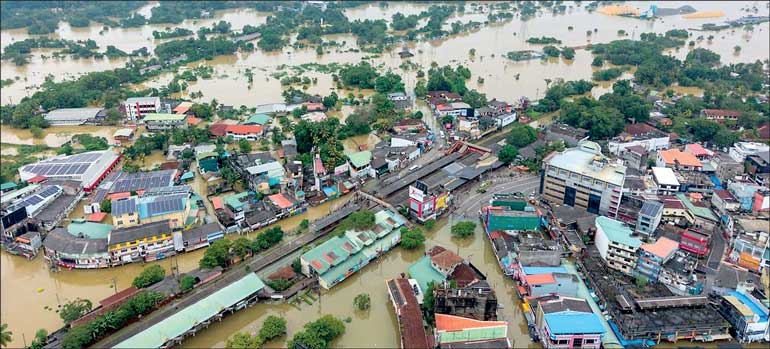
 We are recovering from one of the severest natural disasters. Mother Lanka is in massive pain. Leaders together with all are still in action towards wellbeing of people. Decision making under crisis situations could be confusingly complex unless handled with the needed clarity and commitment. Today’s column reflects crisis decision-making on a global scale with implications to Sri Lanka.
Overview
The recently published UNDP report highlights the stark reality facing Sri Lanka. Their analysis, which draws from disaster related data from the Government of Sri Lanka, provides a nationwide picture of the cyclone’s impact, which is being termed as one of the worst flooding disasters to hit Sri Lanka in decades. Over half of the people in the flooded areas were living in households already facing multiple vulnerabilities before the cyclone, including unstable income, high debt, and limited ability to cope with disasters. Under these conditions, even moderate shocks can turn into long-lasting setbacks.
As the UNDP report further states, the floodwaters reached nearly 720,000 buildings, about one in every twelve buildings in the country. Over 16,000 kilometres of roads, enough to circle the island’s coastline more than twelve times, were exposed to flooding. Similarly, over 278 km of railway tracks and 480 bridges were located in flooded areas.
One essential requirement in crisis situations is sensible decision making and speedy implementation. I found the insights from an article by Louise K. Comfort of University of Pittsburgh, Naim Kapucu of University of Central Florida, Kilkon Ko of Seoul National University, Scare Menoni of Politecnico di Milano and Michael Siciliano of University of Illinois at Chicago, primality in response to CIVID -19 are much relevant today.
Decision-making in uncertain conditions
Public leaders have a key responsibility for protecting the lives and livelihoods of their constituents. In routine times, they may follow time-honored procedures honed over decades of experience, confident that lessons from the past will guide them. As Comfort highlighted, for public leaders facing unknown risks, decision-making is fraught with uncertainty and becomes an adaptive process that has four distinct components: (1) cognition, (2) communication, (3) coordination, and (4) control. Under conditions of COVID-19, how public leaders exercised these four functions proved critical in different contexts.
Cognition
As Comfort further observes, in crisis management, cognition is the “capacity to recognise the degree of emerging risk to which a community is exposed and to act on that information.” Importantly, cognition provides the transition to action. It constitutes not simply the perception of risk to self but also comprehension of the risk to others. That is, action taken may help oneself, but action not taken may irretrievably harm others. The fundamental component of empathy in cognition creates a human connection to others who share the risk and spurs collective action for the benefit of the community as a whole. We saw a glimpse of this reality in the way of handling the first wave of the pandemic in Sri Lanka.
 Public leaders had difficulty recognising the depth, scale, and lethality of COVID-19, observed the authors. From the first slow, sobering discovery of the virus as it emerged in Wuhan, China, to the broad determination that ordinary methods of treating the novel coronavirus were ineffective, cognition came late to public leaders in individual countries as they searched unsuccessfully through old models of dealing with contagion. By the time public leaders recognised the lethality of COVID-19, it was already spreading silently in their communities. While measures to suppress social interaction slowed the spread of the virus, they also created a cruel trade-off by shutting down schools, travel, commerce, and cultural activities that make societies function.
Communication
“It’s going to disappear. One day, it’s like a miracle, it will disappear” repeated US President Donald Trump, many times during early days. It is quite the opposite to what really happened. Communication could be viewed as a process that links sender and receiver in shared comprehension of messages. In doing so, communication creates shared meaning among actors with different roles. It is the means used to inform partner agencies in the global community as well as the public in different nations about the potential risk and rationale for evidence-based mitigation measures and the need for collective response. As the authors clearly observe, effective communication to explain COVID-19 to the public as an invisible, novel, deadly threat requires strong leadership, timely and evidence-based information, and trust to build broad public consensus to support collective action. We Sri Lankans still struggle to convince some sections of the society regarding the needed disciplinary approach.
Coordination
Coordination in this context can be described as the degree to which organisations align their resources, tasks, and time to engage in interdependent functions to achieve a shared goal. In complex environments, coordination requires articulation of shared goals among diverse actors in response to shared risk.
Control
Control can be viewed as the capacity to respond to an external threat and still maintain regular operations in the society. In reference to COVID-19, control meant achieving a reasonable balance between mitigating the spread of the infection, building health care capacity, and managing a safe level of economic and social activity. The global crisis generated by COVID-19 required coordination not only across jurisdictional boundaries within countries but also across national boundaries to bring this massive pandemic under effective control. This is where we had major challenges in Sri Lanka leading to a chaotic second wave.
“Human kindness has never weakened the stamina or softened the fibre of free people; A nation does not have to be cruel to be tough,” so said Franklin D. Roosevelt. The balance between enforcing controls and ensuring continuity is a tough task in the hands of key decision makers. We saw this here and abroad alike.
Clarity in moving ahead
“This pandemic has magnified every existing inequality in our society – like systemic racism, gender inequality, and poverty,” said Melinda Gates last in an interview sometimes ago. The dilemma between public health and economic functions remains at both the global and national scales, observe the authors. This harsh test reveals the collective responsibility that we share for self and others in uncertain situations of shared risk and the critical role of leadership in decision-making and mobilising collective action.
Enhanced coordination and exchange of good practices among member nations of the global community would save not only hundreds of thousands of lives but forgo trillions of dollars in economic losses, anguish, and pain. It would mean expanding networks of research, collaboration, and knowledge sharing among the world’s scientists, scholars, public managers, and students in shared exploration of means for identifying and reducing emerging risks.
Such a move would include building and maintaining a global information infrastructure to support continuous learning and adaptation to a changing environment for both professional practitioners and researchers. It would involve designing and implementing plans for a global health infrastructure and training the personnel who would staff and maintain it, with secure funding sustained by responsible international contributions and oversight. The fact that Sri Lankan health care system, despite its shortcomings has demonstrated its constructive adherence to WHO guidelines is an encouraging sign of a global collaborative effort.
Decisions amidst a weather disaster
The lessons learnt during Pandemic times are relevant and applicable in the current disaster we face as a country. Asia remained the world’s most disaster-hit region from weather, climate, and water-related hazards in recent times. Floods and storms caused the highest number of reported casualties and economic losses, whilst the impact of heatwaves became more severe, according to a new report from the World Meteorological Organisation (WMO).
Sri Lanka is facing multiple challenges. The natural disaster, a severe cyclone, has caused widespread crop destruction, displacement, and infrastructure damage, which threatens to worsen food insecurity and strain the government’s finances, despite a rebound in the economy in 2024. The country is still dealing with the fallout from its previous economic crisis, which included a sovereign debt default and high inflation, though recent reforms have led to economic stability. Sensible decision making with the due consideration of all implications is much required.
As the UNDP recent report observes, the exposed population includes approximately 1.2 million women, 522,000 children and 263,000 older persons, with over 60% of all exposed people living in just two districts (Colombo and Gampaha). Many in affected areas across the country live in high-risk, disaster-prone areas, requiring a permeant solution. This concentration of exposure is placing heavy pressure on essential services. The recovery process is also hampered by resource constraints. Key decisions relating to expanding the expert base, in strengthening the pool of vital volunteers need to be taken.
Way forward
“Be safe, be smart, be kind,” said WHO Director General Dr. Tedros Adhanom Ghebreyesus, in the first months of the pandemic. A similar advice is relevant to us this day and time. Taking correct decisions and implementing them committedly is the need of the hour. “Cyclone Ditwah is a stark reminder of how fast compounding crises can unfold,” said UNDP’s Crisis Bureau Chief of Crisis Readiness, Response, and Recovery Devanand Ramiah. As we discussed, cognition, communication, coordination, and control will be crucial in coordinating multiple initiatives responding to the climate catastrophe. Together we can, and we should.
(The author, a Senior Professor in Management, and an Independent Non-executive Director, can be reached at [email protected], [email protected] or www.ajanthadharmasiri.info.)




