Wednesday Sep 16, 2026
Wednesday Sep 16, 2026
Wednesday, 11 March 2026 00:44 - - {{hitsCtrl.values.hits}}
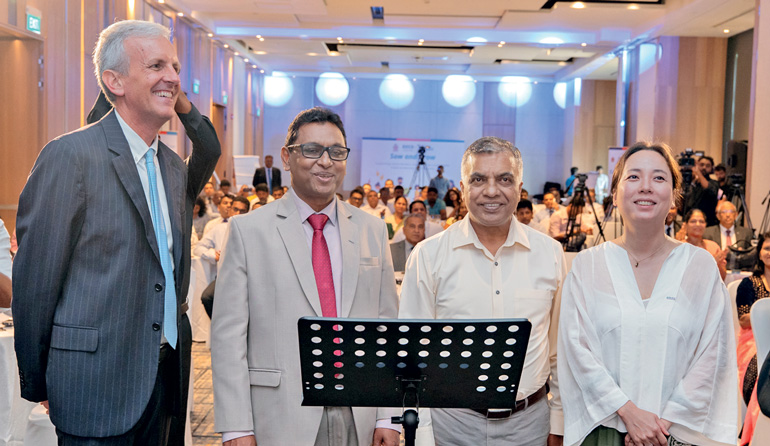
From left: WFP Representative and Country Director in Sri Lanka Philip Ward, Rural Development, Social Security and Community Empowerment Minister Dr. Upali Pannilage, Deputy Trade, Commerce, Food Security and Cooperative Development Minister R. M. Jayawardena and Korea International Cooperation Agency (KOICA) Sri Lanka Office Country Director Lee Yoo Li officially launching the ‘Sow and Grow’ project
By Amira Cader
The United Nations World Food Program (WFP), with support from the Korea International Cooperation Agency (KOICA) and in partnership with the Government of Sri Lanka, has launched a $10 million initiative aimed at strengthening the country’s Thriposha program and improving national food security.
The five-year project, titled “Sow and Grow,” was launched at the Courtyard by Marriot yesterday, bringing together government officials, development partners and agricultural experts to strengthen Sri Lanka’s maize value chain and ensure a reliable supply of Thriposha — the country’s long-standing nutritional supplement for mothers and children.
Thriposha, a fortified food made from maize, soy and milk powder, plays a vital role in supporting the nutrition of pregnant and breastfeeding women and children under the age of five. However, climate variability, rising production costs and post-harvest losses have increasingly affected the availability of high-quality maize needed for its production.
Rural Development, Social Security and Community Empowerment Minister Dr. Upali Pannilage highlighted the importance of strengthening Sri Lanka’s Thriposha program while supporting local farmers
He noted that Thriposha remains a vital nutrition source for pregnant mothers, breastfeeding women and young children, and emphasised the need to ensure a reliable supply of high-quality local maize.
Pannilage said the initiative aims to address these challenges by boosting local maize production and strengthening supply chains. Under the program around 7,500 farmers in Anuradhapura, Monaragala and Badulla will receive support through improved agricultural practices, climate-smart farming methods and better post-harvest management techniques.
By connecting farmers with aggregators and Sri Lanka Thriposha Limited, the project also seeks to strengthen market linkages and ensure a steady supply of high-quality local maize to the Thriposha factory, reducing dependence on imports.
The program is expected to enhance nutrition outcomes for more than 650,000 children under five and over 330,000 pregnant and breastfeeding women across the country.
Opening remarks were delivered by Rural Development, Social Security and Community Empowerment Secretary Sampath Manthrinayake highlighted the importance of strengthening Sri Lanka’s nutrition programs and supporting rural farming communities.
He noted that initiatives such as the “Sow and Grow” project will help improve local maize production, strengthen the Thriposha supply chain and contribute to national food security while enhancing the livelihoods of farmers.
KOICA Sri Lanka Country Director Lee Yoo Li said the partnership reflects a shared commitment to strengthening Sri Lanka’s food systems while supporting rural communities. “Through our partnership with the Government of Sri Lanka and the World Food Program, we aim to support both farming communities and the country’s nutrition security,” she said,
WFP Representative and Country Director Sri Lanka Philip Ward highlighted the importance of strengthening local food systems amid increasing pressures on agriculture. “Maize farmers and processors are facing mounting pressures, from climate shocks to market constraints. By reinforcing the food system through initiatives like ‘Sow and Grow,’ we are safeguarding Thriposha as a reliable, locally produced lifeline for mothers and children across Sri Lanka,” he said.
Department of Agriculture Crop Leader (Maize) Dr. Buddhika Nishantha Abeysinghe outlined key challenges facing maize cultivation in Sri Lanka.
“Low adoption of modern technology, wildlife damage—particularly from elephants—soil degradation and heavy dependence on rain-fed cultivation continue to affect productivity,” he said.
Abeysinhe emphasised the need to improve harvesting and post-harvest handling, including better drying, threshing and storage methods, to reduce aflatoxin contamination and improve grain quality. Nearly 90% of maize cultivation relies on rainfall, making production vulnerable to climate variability.
Health Ministry (Public Health Services) Additional Secretary Dr.Champika Wickramasinghe highlighted the importance of the Thriposha program in improving maternal and child nutrition in Sri Lanka. Introduced in 1973, the program provides nutritional supplementation to about 332,000 pregnant and lactating mothers and around 650,000 children annually.
She noted that strengthening the program is essential to improve nutrition outcomes and support national health goals.
The project will be implemented by WFP in collaboration with several government institutions, including the Rural Development, Social Security and Community Empowerment Ministry, Agriculture Ministry, Health Ministry, Trade, Commerce, Food Security and Cooperative Development Ministry and Finance Ministry
The Sow and Grow initiative will not only strengthen the Thriposha program but also contribute to building a more resilient food system, supporting rural livelihoods while advancing long-term food and nutrition security in Sri Lanka.




