Friday Oct 16, 2026
Friday Oct 16, 2026
Thursday, 5 March 2026 03:33 - - {{hitsCtrl.values.hits}}
By Asia Siyaka Commodities PLC
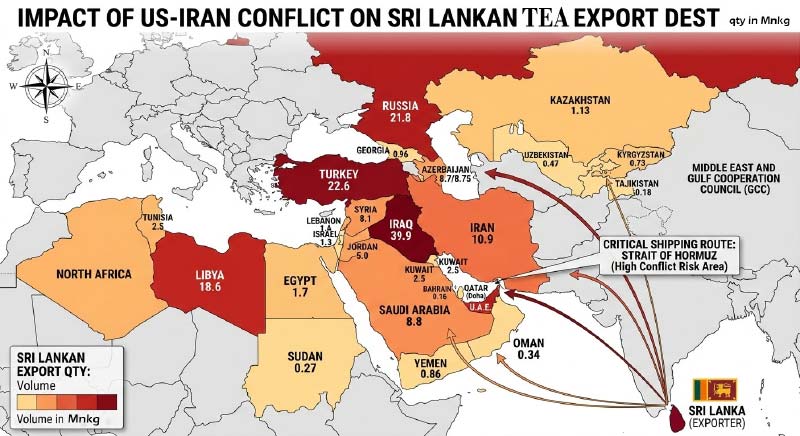
Sri Lanka’s tea industry is facing significant uncertainty following the escalation of military action between the United States, Israel, and Iran on 28 February 2026. The conflict, which has intensified across the Gulf region, is now disrupting global shipping routes, marine insurance coverage, and key export markets for Ceylon Tea.
Ten major markets which collectively imported approximately 43 million kilograms of Ceylon Tea in 2025 are directly affected by the crisis. In addition, exports to a further 12 to 15 countries have been disrupted as shipping lines suspend services, vessels are denied access to certain ports, and insurance constraints make operations commercially unviable. Together, these markets accounted for nearly 70% of Sri Lanka’s total tea exports last year.
Shipping and freight disruptions
A central concern is the situation in the Strait of Hormuz, a key global maritime route for oil, gas, and container traffic. Following warnings issued by Iran, vessel movements through the Persian Gulf have declined sharply, with ships either delayed, rerouted, or awaiting clearance. The resulting uncertainty has affected multiple trade corridors linking Asia, Europe, and the Americas.
Shipping lines serving Europe, North and South America, and North Africa are increasingly diverting vessels around Africa’s Cape of Good Hope to avoid high-risk zones. While this ensures continuity of trade, it has significantly extended transit times and raised fuel and freight costs. Exporters warn that these additional expenses will increase landed prices in destination markets and may affect competitiveness.
War risk insurance and costs
The conflict has also had a knock-on effect on marine insurance. Several major insurers have suspended or restricted war risk coverage for vessels transiting high-risk areas in the Gulf. Where coverage remains available, premiums have risen sharply, with additional surcharges being passed on to shippers. Industry participants note that in some cases, voyages have become commercially impractical.
Despite these disruptions, shipments to East Asian and Pacific markets—including Japan, China, Hong Kong, Taiwan, Australia, and New Zealand—continue without interruption. However, trade analysts caution that prolonged rerouting of vessels could slow container turnaround times globally, potentially creating short-term equipment shortages.
Colombo Tea Auctions
At the Colombo Tea Auction held on 3 and 4 March 2026, market conditions remained relatively resilient. Many categories of tea held firm, and although certain grades declined in value, they remained saleable without steep discounts. However, unsold lots rose to between 15 and 18%, higher than in the previous two weeks. Market participants warn that if instability persists, unsold volumes could increase further in the weeks ahead.
Private tea factories and Estates are expected to face growing cash flow pressures. Rising unsold stocks and softer auction prices may lead to trading losses, placing strain on working capital. The timing is particularly sensitive, as factories traditionally provide substantial cash advances to Smallholder Farmers and Workers ahead of the Sinhala and Tamil New Year in early April.
Lower auction prices are also likely to translate into reduced bought-leaf rates paid to farmers. Compounding the situation, prevailing dry weather conditions have reduced crop intake, limiting farmer income. Industry observers further caution that any fuel shortages could disrupt the transport of green leaf from smallholders to factories and the movement of made tea to Colombo for auction.
With no clear end to the geopolitical tensions, stakeholders across the tea value chain are closely monitoring developments. Should the conflict continue, freight rates are expected to remain elevated, liquidity pressures may intensify, and farmer incomes could come under further strain. Conversely, any de-escalation and restoration of secure shipping routes through the Gulf region would likely stabilise freight costs and support auction performance.
For Sri Lanka’s tea industry—one of the country’s most vital export sectors—the coming weeks will be critical in determining the scale and duration of the impact.




