Wednesday Sep 16, 2026
Wednesday Sep 16, 2026
Thursday, 14 May 2026 00:02 - - {{hitsCtrl.values.hits}}
By Aanya Wipulasena and M. F. M. Fazeer
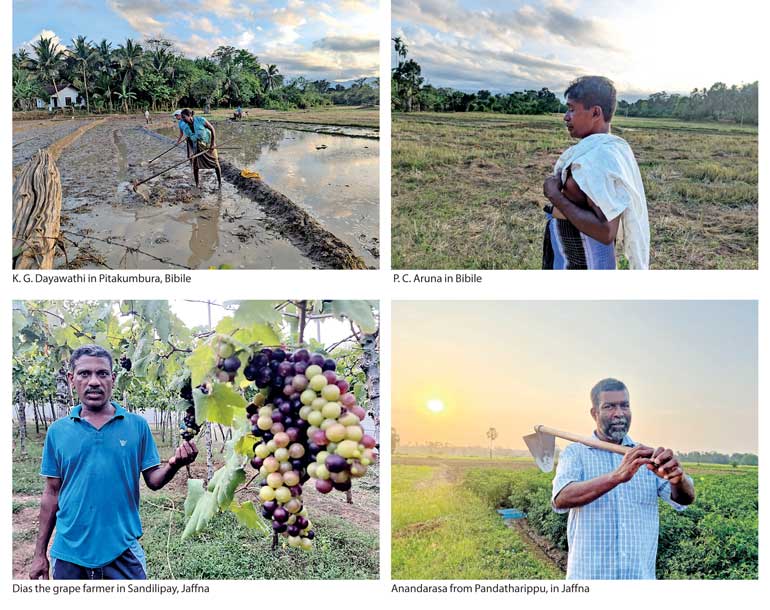
The scorching sun has been relentless, yet 70-year-old K. G. Dayawathi and her neighbors continue working in their paddy field in Pitakumbura, Bibile. For them, the mantra is simple, cultivate the field, and it will provide enough rice and income to carry them through the next few months.
But Dayawathi, who has been farming since she was just 15 years old, is worried. Soon their field will need fertilisers, but a looming scarcity in the open market has become a serious concern.
“There are so many of us (farmers) who are anxious. What can we do? We just hope we’ll get fertilisers in time,” she said.
In the field next to hers, 33-year-old Dinushi Madumali, has just finished preparing the land for sowing. She said she went to several fertiliser shops to purchase Urea, the fertiliser that she’ll need immediately for her field, but to no avail. The shops in the nearest town that had stocks, were selling at an inflated price.
“Without Urea the plants will wither. There won’t be a rice harvest, so there’s no point cultivating the field without it,” she said.
She remembers in 2022, when the government banned chemical fertilisers, they were given an alternate fertiliser that didn’t help the yield. She says if Urea stocks run out, she’ll simply stop farming.
Similar concerns are being echoed by farmers in the Northern Province, where many say fertiliser shortages and rising prices are already affecting cultivation decisions.
Anandarasa from Pandatharippu, in Jaffna, said he abandoned plans to cultivate this paddy season as fertiliser and fuel costs are soaring making it impossible for him to bear the cultivation costs. He said he was worried. “If this continues, we will not be able to cultivate Maha (next season) too,” he said.
Meanwhile the plight of farmers growing other crops such as chili and pumpkin in Pandatharippu are facing a new hurdle.
“Fertiliser dealers are insisting us to purchase additional fertiliser products before they agree to sell us urea. We don’t even want those products. It’s an added cost. But we have to buy anyway because without urea our crops will fail,” T. Ravinshandran said.
Then to growers of high-value crops, the pressure is even greater. In Sandilipay, Jaffna, grape farmer Dias is still recovering from losses caused by cyclone Ditwah. He said the soaring cost and uncertainty of securing fertilisers for his grape vineyard could severely affect the next season.
“It is not easy to grow grapes. We have to protect it from rain, bats and all of this is extremely costly. To break even we need consistent fertiliser application to maintain a good yield and the quality of the fruit.
“Adding to that is the cost of transportation. If I can’t afford to send the harvest to other parts of the country, I’ll have to sell this in Jaffna for a lesser price. I really worry for the future of grape farming,” he said.
Economist Rehana Thowfeek warned that rising global fertiliser prices and issue of availability of supplies could place the country’s agricultural sector under severe strain in the months ahead, particularly if shortages continue into the next cultivation season. Urea, she said, is twice the pre-war price.
“If the shortages persist for over six months, then the next Maha season will be extremely hard hit. Sri Lanka will face food shortages given the lack of availability and affordability of fertiliser. It›s a major blow considering the existing vulnerabilities after the economic crisis. Poverty doubled, real wages fell, two out of every five Sri Lankans already cannot afford a healthy diet,” she said.
However, Thowfeek stressed that the current situation should not be viewed as a repeat of the 2022 fertiliser crisis, when the government’s overnight ban on chemical fertilisers severely disrupted agricultural production.
“It is not completely right to compare this to 2022. That was a crisis of our own making. In this case, we are facing a crisis created by someone else,” she explained. “In 2021, we went to zero percent non-organic fertilisers. This time, that is not the case. We do have some fertiliser stocks available and are actively trying to get more.”
“The impacts in the near term will be bad, though not as bad as with zero percent fertiliser use. We are already seeing tea production fall, for instance,” she said. “In the long run, if there are continued shortages, we could face prolonged effects,” she said.
According to statistics shared by the National Fertiliser Secretariat (NFS) this Yala season requires around 125,000 tons of urea, while the upcoming Maha season 180,000 MT.
Chandana Lokuhewage, Director of the NFS, says Sri Lanka currently has sufficient urea stocks to meet demand for the ongoing Yala cultivation season, despite rising global fertiliser prices linked to international supply disruptions.
Speaking on fertiliser availability and distribution, Lokuhewage said by early March, Sri Lanka already had 101,000 tons in stock, while an additional 50,000 tons was procured recently, of which 25,000 tons has already arrived in the country.
“As a result, we now have nearly 150,000 tons of urea stocks, which is more than the requirement for this season,” he said. Of that amount, around 80,000 tons has already been distributed for paddy cultivation and other agricultural crops. He noted that available stocks would be sufficient for both this month and next month.
Lokuhewage explained that during the recent period of global disruption linked to the war in the middle east, authorities temporarily restricted the distribution of urea through private fertiliser vendors in order to manage supplies through the government-backed Govi Jana Seva centres and avoid shortages for farmers.
At the time, approximately 68,000 tons urea remained in stock, with around 65 percent allocated for distribution through Govi Jana Seva outlets.
The Government-controlled price of a 50kg bag of urea remains at Rs. 9,500, while transport and handling costs bring the maximum selling price to around Rs. 10,200, he said.
However, newly imported stocks were purchased at significantly higher prices, ranging between $650 and $850. Due to the higher import cost, authorities have now permitted private fertiliser retailers to resume sales in the open market.
“Since there are around 2,000 private fertiliser shops and they have their own customer base, permission has now been granted for them to sell urea as well,” Lokuhewage said.
He added that open market prices for a 50kg bag of urea imported under the new pricing structure are expected to range between Rs. 15,000 and Rs. 16,000.
“The new prices are high and we cannot control them. We informed suppliers that fertilisers were urgently needed, and they secured the stocks,” he said.
Meanwhile, Lokuhewage said supplies of other fertilisers required for the Yala season remain adequate. An additional 18,000 MT of MOP (Muriate of Potash) fertiliser is expected to arrive during the first week of June, while TSP (Triple Super Phosphate) stocks are also currently sufficient.
Looking ahead to the Maha cultivation season, Lokuhewage warned of potential supply pressures, particularly for urea. Sri Lanka is expected to require around 180,000 tons of urea, 25,000 tons of TSP, and 50,000 tons of MOP for the next major farming season.
The government has already floated a tender for 20,000 tons of urea and has also advised private sector importers to secure adequate stocks ahead of Maha. However, he cautioned that sharply rising global fertiliser prices remain a major concern.
“Previously, urea could be purchased at around $450. Now prices have risen to nearly $800, and we have to compete in that market,” he said.
In Bibile, farmers are weighing in their options. “I don’t think it is viable to cultivate paddy in hopes of selling the yield as production cost will keep skyrocketing. Farmers just can’t make a profit at this rate. Some of us have already stopped selling our harvest and cultivate paddy for our own consumption. I see that more and more farmers will do the same,” farmer P. C. Aruna said.
- Pix by Aanya Wipulasena




