Wednesday Sep 16, 2026
Wednesday Sep 16, 2026
Thursday, 18 September 2025 02:42 - - {{hitsCtrl.values.hits}}

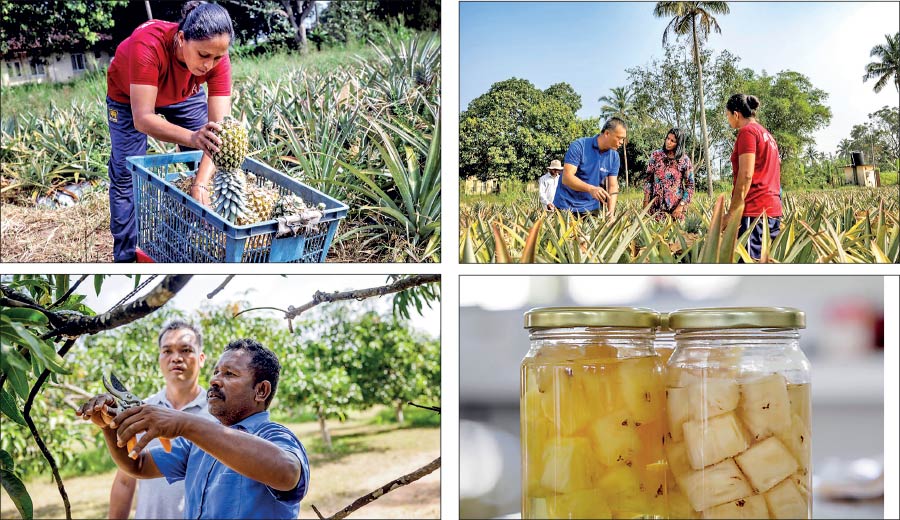
Shantha Dissanayake, a mango farmer in northern Sri Lanka, has spent a lot of time worrying about elephants stomping over his mango orchards. But he became even more scared when agricultural experts came from abroad and hacked his trees down to relative shadows of their former selves.
“These outsiders came and hacked down all my trees to stubs with only a few leaves left. They looked close to dead,” he said. “However, this experiment has turned out a complete success,” he added.
The trees are much shorter than before, with fewer but wider branches that allow sunlight to boost fruit quality and naturally prevent plant diseases. “Now I see that it works,” said Shantha, a 53-year-old man in perpetual good spirits, whose hobby and obsession is fixing a rusty old tractor he used as a younger farmer growing squash and maize.
Less tree, more mangoes
Zengxian Zhao, the man who cut the trees in the first place, laughed at Shantha’s memory. “He was initially shocked, but he’s been convinced and is spreading the word,” said Zengxian, an expert on crop cultivation, dispatched by China’s Ministry of Agriculture and Rural Affairs.
He was deployed in 2023 in this Food and Agriculture Organisation of the United Nations (FAO) project focused on Sri Lanka’s tropical fruit sector, aiming to boost the incomes of the farmers who produce bananas, pineapples and mangoes, high-value fruits that can flourish in the country.
“Here the farmers know how to make mango trees big, tall and very strong,” Zengxian said while chatting with Shantha on his farm outside Anuradhapura. It has become a kind of exposition centre where Shantha’s neighbours come to learn about the new techniques being shared through the FAO-China South-South Cooperation (SSC) project.
“I explain and show Chinese pruning methods that are very different,” Zengxian said. “We are looking to make more of the plant nutrients flow to the fruits.”
Zengxian’s pruning method – which he has demonstrated to hundreds of Sri Lankan farmers at more than 30 sites around the dry and sparsely-populated North-Central Province – is manually simple. It follows a fractal logic wherein the crown of each mango tree is hollowed out and the number of spindles per branch reduced by half.
In essence, he serially splices the tree, starting at about 70 centimetres up the trunk, replicating the pattern of leaving four rather than the typical seven branches at each point to open the canopy in a way that enhances fruit productivity. Ultimately, the ideal is to have one tree with about 87 branches, each producing one or two ovoid-shaped mangoes, ideally weighing just over 500 grams.
Shorter mango trees make it easier to bag and pick the fruit at harvest, which is done by hand. Greater exposure to sunlight additionally reduces opportunities for invasive pests, lowering both labour requirements and agrichemical costs.
Shantha says that while gross yield per pruned tree has dipped somewhat, his net marketable yield has jumped by 50%, as he now obtains mostly prime-grade fruit whereas before the majority of his fruits were too small or irregular and had to sold at give-away prices.
Shantha describes himself as a convert to the new techniques he has learned and now plans to adopt them on the rest of his trees. He is convincing his brother-in-law Jayasekara to do the same on his nearby farm, where mango trees tower up to three times higher but with only marginal economic yields.
At the moment, Jayasekara uses a long bamboo pole to knock down fruits from the upper branches, which usually bruises them to the point where they have to be turned into chutney on the same day or perish. With shorter trees, this wouldn’t be the case.
The pineapple predicament
Further south, in the towns of Makandura and Horana, the tropical climate poses a special challenge as year-round heat and two big rainy seasons catalyse greater pest risks, said Yangyang Liu, whose focus has been on the pineapple value chain.
Flooding has been a major issue as well that led to many farmers abandoning pineapples. He and his colleagues from the Chinese Academy of Tropical Agricultural Sciences have shown how inexpensive field management, such as raised soil beds and novel mulching techniques, help mitigate that risk.
The Chinese experts’ other practical advice for improving pineapple cultivation focused on irrigation, integrated fertigation networks that result in “more application but less use” of costly fertilisers and land cover sheaths to maintain soil moisture and minimise the runoff of expensive agrochemicals.
Together these initiatives sharply reduced labour needs for weeding, which is particularly ornery with the spiny variety grown in the region. Placing bags around the growing fruit helps block sun scorching, which in turn helps identify the actual ripening stage with greater precision and leads to tastier output.
Critically, Sri Lankan farmers learned how to use crown propagation, a method of generating fresh planting materials that is considerably more efficient and addresses one of the main cost barriers local pineapple cultivators face. This method more than triples the amount of new planting material generated by existing plants and responds to one of the main demands local farmers have.
Suneth Lakmal, a long-time pineapple farmer, says that more available material and the more climate-resilient techniques he has learned has helped him nearly triple the number of pineapples he can grow to 20,000 per acre.
He is so confident that now he plans to double the amount of land he leases, boosting production to the point where he can try to negotiate export deals. Given his new method’s reduced reliance on costly pesticides and improved water efficiency, he dreams of expanding into becoming a large-scale farmer. “I don’t feel any limits to how much I can cultivate,” he said.
Dharshini Erangika Jayamanne, Director of Agriculture at the Research and Development Centre in Makandura, north of the country’s capital Colombo, set up a model pineapple farm that achieved three times typical local pineapple yields using the low-cost technology showcased by the project. Moreover, the fruits are higher quality and have uniform harvest times, boosting scale to meet the needs of foreign buyers.
Working with the experts, she innovated a way to generate new plant materials for pineapple and bananas – known locally as suckers – in a way that harmonises seasonality and reduces the spread of plant diseases. She also led the training of more than 1,000 farmers and students through workshops.
While initial participants received financial help with upfront costs, they can be recovered in less than three seasons and sometimes just one, she reckons, making facilitating credit rather than offering grants a viable opportunity for the Ministry.
“The key to this project was guidance and the scientist-to-scientist rapport. Because they are always with us, we could always come up with fixes to local challenges which is the key point in the success of this project,” said Dharshini, who herself is an accomplished scientist with breakthrough innovations in pineapple tissue culture. She plans to take the FAO project and make it “readable and transferrable” to regional research centres.
“Extension services are essential going forward and are essential to avoid anyone falling into improper beliefs about technology failures,” she said. “Just learning things from the Internet does not turn out to be so successful.”
Some of that outreach happens spontaneously. A common refrain among the farmers participating in the project is that their neighbours ask them to learn more.
“They’ll look over the wall and ask why I am planting so densely, and I tell them about the FAO project,” said Seela Wickrama, who is turning her parents’ small holding from a betel farm into a multi-crop enterprise focusing on pineapples and bananas. She also noted that while she benefits from start-up grants thanks to the project, she will now also invest in them on her own.
Long-term benefits
Participants in the SSC project receive grant funding to defray some up- front investment costs, such as installation of irrigation systems, while Sri Lanka’s Department of Agriculture is paying half of fertiliser costs. That help is key in the demonstration phase, but once accepted at scale, the approach is “relatively light on capital” and can be “beneficial to smallholders even without public incentives,” says Bandara Abeysinghe, a provincial agricultural instructor who has been helping the FAO project reach a larger audience. The real benefit of the project is the capacity building, learning new, simple and low-cost techniques to increase production.
Shantha agreed. “I don’t want free stuff or subsidies, but long-term loans,” he said. With proof of increased productivity, bank loans are easier to access. The Government’s goal, Abeysinghe notes, is to increase productivity of tropical fruit farming, not necessarily to promote mango, pineapple or banana production over the region’s other core crops, which include chili, soya and various kinds of rice.
“If done well farmers get a higher return on investment,” he said, adding that his team will be giving 50 courses a year on Zengxian’s pruning techniques.
Going local to go global
What Shantha, Suneth and other producers in Sri Lanka really want is to find a way to tap the $ 11 billion global tropical fruit market, which offer considerably higher prices.
The popular TJC mango variety Shantha grows is appreciated for having small seeds, meaning more, smoother and fleshier pulp, and has been the catalyst of a recent upswing in exports to the Middle East. Still, total exports amount to around 430 tonnes, including dried fruit, less than one percent of national production.
However, unleashing the formidable potential of tropical fruits to help livelihoods reliant on transforming Sri Lanka’s agrifood systems involves more than just sorting out paperwork.
Those challenges overlap with issues such as local procurement and in particular transportation, which for fresh tropical fruit is a delicate process from start to finish. The experts from China have taught effective techniques such as placing pineapples upside down in crates to minimise jostling during transport.
However, nothing is as simple as it seems. Even using plastic crates is a systemic intervention, as they have to be recycled back to where they are needed, and wholesale markets need to be revamped and weaned off habits of using bags or open mounds of fresh fruit on exposed trucks and at warehouse depots.
Gradually pushing through this reform has been a major contributor to the reduction by half of food loss and waste, said Chandana Wasala, Deputy Director of the National Institute of Post Harvest Management, a research centre originally set up with FAO’s assistance in 1976 to improve rice processing in the country.
Jars of heirloom rice varieties line the institute’s laboratories, where young researchers now focus on food-safety assessments of mango jams and other processed foods using misshapen fruits. Somewhat ironically the institute is home to towering 25-metre-high mango trees, which serve for shade and ornamentation rather than production.
The project has offered a platform to launch a broad regional awareness campaign about food loss, said Chandana, who has researched the financial and practical considerations that drive actors in the value chain – especially traders and transporters who see it as an extra cost - to resist replacing poly-sack bags with plastic crates.
As part of the project, Chandana took some of his team to China for a tour and training programme and picked up on how transforming Sri Lanka’s tropical fruit sector is a systemic enterprise, in many ways requiring the same market integration and efficiency challenges China overcame in recent decades with its large internal market.
Since then, he, Zengxian and Yangyang have worked with local colleagues to conduct around 80 “training of trainers” sessions and meet hundreds of farmers to explain small-scale actions that can be done now to deliver outsized impacts.
One underappreciated issue is that materials for bagging fruit, chemical inputs for herbicides and fertilisers and irrigation piping are relatively expensive in Sri Lanka.
“I’ve found that all the farmers are eager to try these new techniques, but compared to China, they often can’t get what they need locally at a good price, exacerbating the financial strain,” said Dequan Sun, leader of the experts deployed on the project.
Dequan huddled with local suppliers to invent affordable alternatives for products ranging from fruit bags to fertiliser mixes. “The farmers here have been doing this for centuries and are good, and we’ve learned a lot from them and about local fruit varieties,” he said. “But there is room to improve and that’s why we’re here. Being here for two years, two whole seasons with all the phases, means that our training and our model demonstration farms are intensive and allow people to grasp how they can increase production and yields.”
The intense contact means that farmers and technical experts find alignment in their quest for viable solutions that take the Chinese know-how and fit it to the Sri Lankan circumstance, allowing both sides to learn. “Every time we have a problem, we discuss a lot and solve it so that we all know what is going on,” said Yangyang. “Responding to questions is the best way.”
Transferring knowledge
The whole project, which includes innovations in Sri Lanka’s banana, mango and pineapple sectors, is emblematic of the South-South Cooperation theme, consisting of technology transfer, precision agriculture, legal trading norms, transportation and marketing methods and the adoption and upscaling of good agricultural practices.
“This method benefits both individual farmers and the country’s economy,” said Shantha.
The $ 1.5 million SSC project is a “pilot and a proof of concept”, said Vimlendra Sharan, FAO Representative to Sri Lanka. Putting plastic bags around fruit to prevent sun scorching, harmonise ripening and fend off pests is “not mind-boggling technology,” he noted. The real added value here is that the experts from China are right there, over several seasons, to see challenges, not for a one-off tutorial, he added. “Farmers are amazingly instinctive at understanding each other.”
Keeping up the momentum
Zengxian and his infectious enthusiasm and Yangyang with his fluency in Sinhala and poetic nostalgia for serene scenes of “buffaloes in paddy fields with herons standing nearby”, have now left the country after two years during which they helped deliver hundreds of hands-on tutorials to more than 1,900 farmers as well as scores of extension workers, trainers and students.
However, Kuragamage Don Lalkantha, Sri Lanka’s Minister of Agriculture, Livestock, Land and Irrigation since late 2024, is committed to making sure the SSC project will live on and evolve. Lalkantha is a no-nonsense man who wants to help turn his country around after a dramatic economic collapse in 2022.
Noting that many past development projects ended up with “no results or outcomes,” he is focused on restoring benefits from the high-value agricultural produce for which his island nation has been famous for millennia.
“We need investments from abroad… and must focus on increasing production and boosting exports,” he said. “Our country is home to a wide variety of fruits, but we have not yet been able to preserve this diversity and present it to the world effectively… We are deeply interested in making this a reality.”
Ministerial officials across all provinces are collaborating more closely to ensure that the agricultural sector is generating meaningful and inclusive results that also reach the poorest individuals and contribute to food security for all. The Government has set up cost-sharing schemes whereby it subsidises irrigation equipment, plastic crates and other items farmers need to upscale the project’s results.
Public officials on the front line agree. “After completing these research and field experiments, we have a very clear idea on how to scale up these technologies, and I believe it will have a very big and positive effect,” said Dharshini. “The experts from China did a very big job boosting our confidence… We are stronger and ready to take our battle alone into the future,” she added.
“There is a long road still to go” before Sri Lanka’s family farmers can export tropical fruit at scale, noted Yangyang, who has canvassed major global fruit companies to understand their needs, but they are on the right track.
“We have a local saying that the way to get rich is to grow mangoes out of season,” said Shantha. With the new low-cost South-South shared technologies, he is now confident there is another more viable way.
Pix by David Blacker/FAO




