Saturday Oct 17, 2026
Saturday Oct 17, 2026
Thursday, 16 July 2026 00:19 - - {{hitsCtrl.values.hits}}
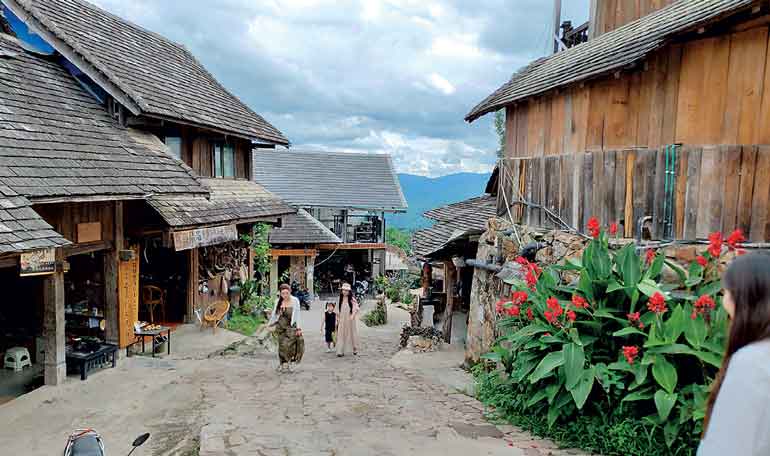
Wenghi village
Text and Pix by Shanika Sriyananda in Jingmai, Yunnan
The journey through the gentle, misty ancient forests of Jingmai Mountain in China's southwestern Yunnan Province brought a feeling close to my heart. It reminded me of the scenic hill country of Nuwera Eliya, where the cool climate has resemblance to Jingmai, home to China's living tea heritage.
What makes this ancient tea forest truly unique is that tea has never been cultivated in neatly manicured rows, as in Sri Lanka. Instead, the trees have been allowed to grow naturally beneath towering forest canopies. Centuries-old tea trees stand alongside younger ones, thriving within a rich and carefully preserved ecosystem with minimal human intervention.
Jingmai is not merely a tea plantation but a living cultural landscape where tea, biodiversity, indigenous traditions and economic prosperity have evolved together for more than a thousand years.
Jingmai Mountain stands as a natural museum of Pu'er tea and became the world's first tea-themed UNESCO World Heritage Site in 2023. It was recognised as an extraordinary example of sustainable agriculture rooted in culture, spirituality and community.
Wild tea trees
Located in the heart of Pu'er City in Yunnan Province, close to the borders of Myanmar, Laos and Vietnam, the region is home to the indigenous Bulang and Dai communities, whose ancestors first cultivated wild tea trees more than a thousand years ago. Today, over 3.2 million ancient tea trees continue to flourish across nearly 1,900 hectares of protected forest, with some trees estimated to be over 1,000 years old.
Unlike conventional tea plantations, where forests are cleared to make way for cultivation, Jingmai's tea forests remain largely untouched. Tea grows beneath native forest canopies, where the natural ecosystem provides shade, regulates temperature and humidity, enriches soil fertility and naturally controls pests without relying on chemical fertilisers or pesticides.
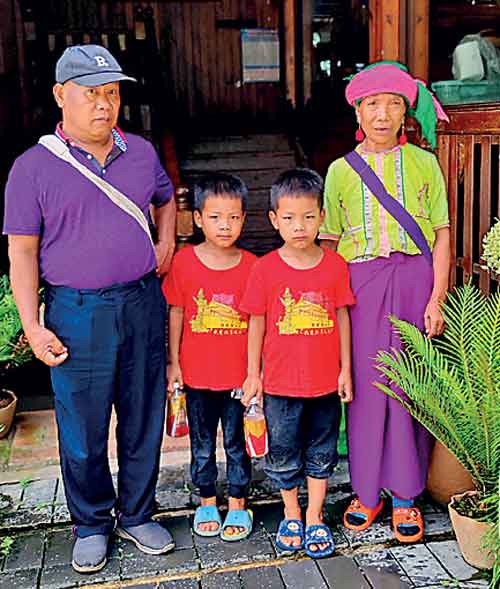
Village family turned their old house to a tea boutique
For the Bulang and Dai communities, cultivating tea is not simply an occupation but an inherited way of life. For thousands of years, they have practiced sustainable land management while preserving both their forests and their cultural traditions.
Among these communities, tea is regarded as sacred. Every tea forest contains a tea spirit tree, and villagers perform annual ceremonies to honour their ancestors, whom they believe introduced tea cultivation to the mountain.
In Jingmai, tea has long been recognised as far more than an income-generating crop. It forms the very foundation of these ethnic communities.
In the ancient forests of Jingmai, tea is far more than a beverage. It is history preserved in every leaf, culture passed from one generation to the next, and a living reminder that economic prosperity and environmental conservation can flourish together.
Guiding a delegation of 19 journalists through the ancient tea forests and the traditional Bulang village of Wengji and the Dai village of Nuogan, Xiong Dengkui explained how tea shapes every aspect of community life.
The journalists, representing several mainstream media organisations, including the Daily FT, were invited by the Yunnan International Communications Centre (YICC) for South and Southeast Asia in collaboration with the Association for Sri Lanka-China Social and Cultural Cooperation.
"They respect tea because it has brought them prosperity and improved their living standards. But beyond its economic value, tea is deeply spiritual. It is woven into their beliefs, traditions and everyday lives," Dengkui said.
According to Dengkui, tea is an integral part of every important stage of their life from religious ceremonies and festivals to weddings and even times of illness.
"When a daughter gets married, her family traditionally gives her a small plot of tea land," she explained. "Tea is not simply property but it is a family's inheritance and security for future generations."
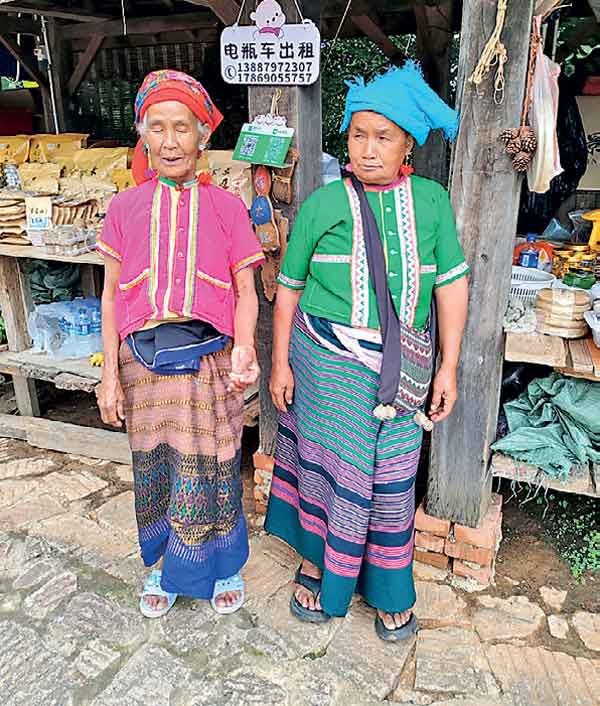
Tea sellers at Wengi Blang Ancient village
The community's spiritual connection with tea is most visible during the first spring harvest, when villagers perform ancient rituals to honour the tea spirit before picking the season's first leaves.
"They believe that everything in nature, from the grass beneath their feet to the tallest trees, has a spirit. Before the first spring harvest, they worship the tea spirit to express gratitude and pray for a good season," Dengkui said.
Land ownership
Land ownership in Jingmai also differs significantly from the plantation systems found elsewhere in China.
Although the land is owned by the State under China's legal system, families within these ethnic communities have inherited the rights to cultivate specific tea forests for generations.
"The Dai and Bulang families have lived on this mountain for centuries. Their ancestors passed the tea forests down from one generation to the next," Dengkui explained.
She said that there are very few physical boundaries to demarcate their lands and every family knows exactly where its inherited land begins and ends.
“There is mutual respect for each other, so disputes are extremely rare," Dengkui opined.
Today, more than 90% of the income earned by over 4,000 families is generated directly from tea. Around 6,000 people belonging to five ethnic communities continue to live across the villages of Jingmai Mountain, preserving traditions that have remained largely unchanged for centuries.
Unlike estate workers in Sri Lanka, tea growers in Jingmai work independently.
"They are not employees of tea companies. They decide when to harvest, collect their own tea leaves and sell them directly. Some sell to tea companies, while local cooperatives and government agencies also help connect them with markets," Dengkui said.
According to Dengkui, household incomes fluctuate with the harvest seasons, particularly during spring, when tea harvested from ancient trees commands premium prices.
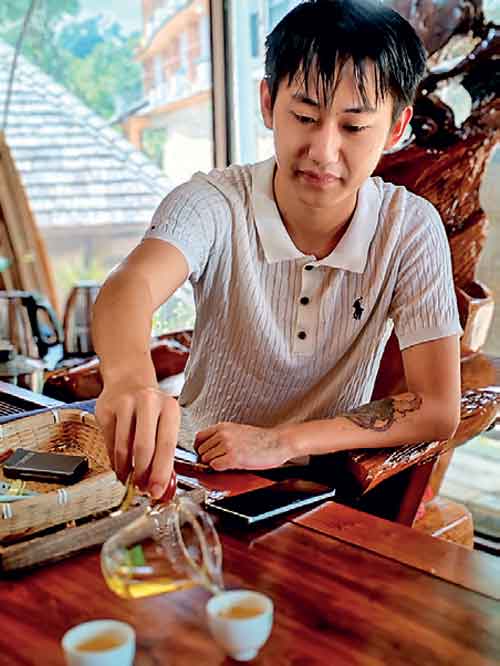
Luo Minhyu - Computer science graduate turned to a tea seller
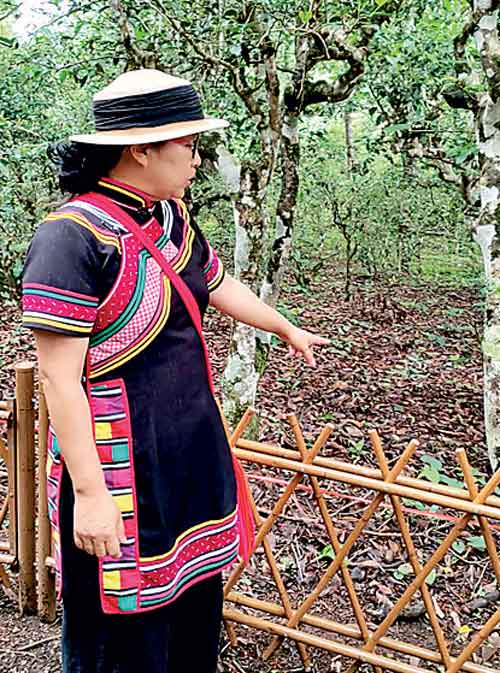
She explained that tea trees vary considerably in height. Many are maintained as bushes at around 1.5 to 2 metres to make harvesting easier, while the ancient tea trees have grown beyond nine metres, forming a natural canopy over the forest beneath.
"There are tea trees that are more than 10 to 15 metres tall, and they continue to grow even taller," she said.
According to the UNESCO World Heritage website, Jingmai Mountain produces nearly 4,000 tons of tea during the spring harvest each year. This represents only around 0.1% of China's total annual tea production, which exceeds 3.5 million tons.
Despite its relatively small output, the Chinese Government places special emphasis on Jingmai tea because of its exceptional cultural, ecological and economic value. Rather than competing in volume, Jingmai has positioned itself as a premium specialty tea with unique heritage value, fetching significantly higher prices in niche domestic and international markets.
For Sri Lankan tea, which has carved a name Ceylon Tea for over 150 years, the tea story of Jingmai will be a fine model on how tea cultivation has integrated into heritage, tourism, conservation, branding and rural development with the participation of estate communities
Urban migration has become a major challenge for many rural regions across China, with young people increasingly seeking employment in cities. Jingmai, however, is witnessing the opposite trend. More young people are returning home after completing their education, recognising the growing business opportunities within their own communities.
Careers in tea
Twenty-five-year-old computer science graduate Luo Minhyu chose to return to Wengji village instead of pursuing a career in one of China's major cities. Today, he manages his family's tea business while using e-commerce platforms and social media to market Jingmai tea to a wider audience.
"I realised there are more opportunities here than in the city. After Jingmai became a UNESCO World Heritage Site, more tourists started visiting, and more people learned about our tea through social media," he said while carefully brewing high quality preserved tea from Jingmai Mountain.
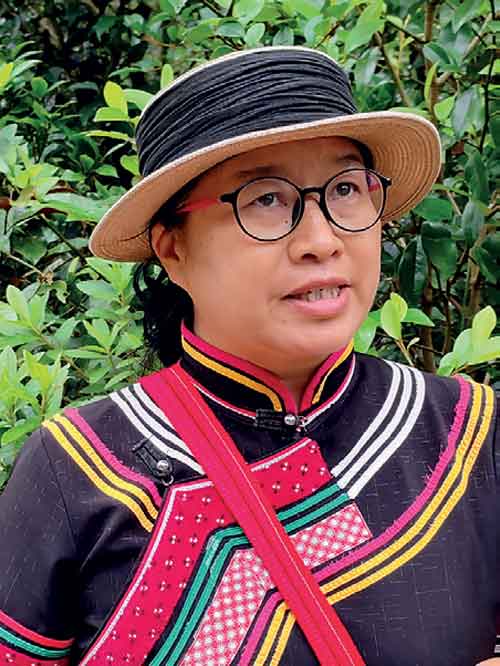
Xiong Dengkui
Watching Minhyu patiently and carefully brewing the sun-dried tea leaves until they turned a delicate amber before gently pouring the tea into small white cups was, in itself, a calming and almost therapeutic experience.
Together with his girlfriend, who is also his business partner, Minhyu has opened a tea house and a boutique guesthouse, offering visitors an authentic tea experience in Wengji village, surrounded by ancient tea forests.
"We wanted people to experience our tea culture, not just buy tea. Young people can now build businesses in their own villages because there is a growing customer base," he said.
Minhyu’s story reflects how Jingmai's international recognition has inspired more young people to return home, combining technology, tourism and entrepreneurship to preserve their cultural heritage while creating new economic opportunities.
Many are establishing boutique homestays, tea houses, cafés and cultural centres while promoting Jingmai tea through digital platforms and international markets.
The Chinese Government has invested heavily in further developing the site through improved road networks, visitor centres, museums and other infrastructure while carefully preserving its original natural ecosystem.
According to Prof. Li Zhirong of Zhejiang University, one of the key reasons behind China's success in protecting sites such as Jingmai Mountain is that heritage conservation is regarded as a national responsibility rather than the duty of a single institution.
National endeavour
"Preserving cultural heritage in China is a national endeavour. It is supported by local communities, government agencies, universities and researchers. Heritage conservation is not the responsibility of one entity, it is the responsibility of the entire country and every Chinese citizen," Prof. Zhirong said.
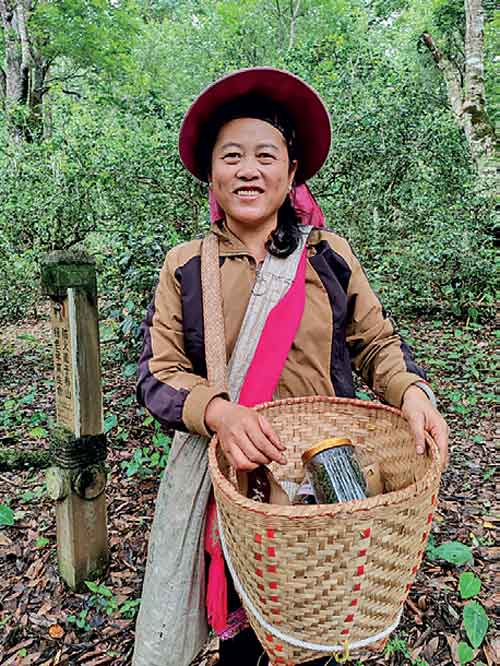
A tea plucker
She noted that this collaborative approach has enabled China to safeguard its cultural landscapes while creating sustainable economic opportunities for local communities through tourism, education and cultural industries.
Prof. Zhirong said China's tea culture reflects centuries of tradition, where quality, aroma and place of origin remain central to the tea-drinking experience. This, she noted, differs markedly from many countries that experienced colonial rule.
"In China, Japan and South Korea, people generally drink tea in its original form because they appreciate its natural flavour and health benefits," she explained.
"But in many South Asian and Southeast Asian countries, tea is commonly consumed with milk, sugar and other ingredients. It is a practice shaped largely by colonial influence."
Today, China is the world's largest producer of tea, accounting for nearly half of global production, with Yunnan ranking among its most important tea-growing provinces.
Yet the beauty of China's tea story lies not only in its scale of production. While millions of tons of tea are harvested annually across the country, Jingmai secures a unique place within the industry. Producing only a small portion of China's total tea production, the Jingmai Mountain has built its reputation not on volume but on authenticity, heritage and quality, serving a niche market that values its premium ancient tree tea.
For Sri Lanka, whose Ceylon Tea has earned a global reputation over the past 150 years, Jingmai offers valuable lessons that extend well beyond tea cultivation.
Rather than viewing tea solely as an agricultural commodity, Jingmai demonstrates how heritage, biodiversity, indigenous knowledge, tourism and community participation can be woven together to create a sustainable rural economy within its ancient ethnic communities.
Jingmai success lies not in producing more tea, but in producing a story that the world is willing to value.
As Sri Lanka continues to strengthen the global identity of Ceylon Tea, the experience of Jingmai presents a fine model of how tea can be transformed from a plantation crop into a living cultural heritage.
It protects forests, empowers rural communities, attracts high-value tourism and demands high prices in international markets.
This is not an impossible endeavour for Sri Lanka’s tea to reach similar heights if more dedication, commitment and strong policies are in place to take Ceylon Tea to tap more markets internationally.
Although Sri Lanka’s historical tea estates have not yet been inscribed on the UNESCO World Heritage List, its hill country tea regions- Nuwara Eliya, Dimbula, Hatton and beyond – still remain on UNESCO’s Tentative List as a proposed 'Tea Cultural Landscape'. It states that the country's tea plantation system is a living cultural landscape shaped during the colonial period.
In its proposal Sri Lanka has highlighted the island’s unique plantation system shaped during the British colonial era, where tea estates have evolved into a living cultural and economic landscape combined with communities, architecture and labour traditions.
If this inscribe, which explains the Sri Lanka’s tea heritage, has gained world recognition and if the stakeholders carefully planned the future of the country’s tea sector collectively, Ceylon Tea will have a more brighter future like Jingmai Mountain tea to have a niche market for its heritage black tea to fetch higher prices in the international market and to improve the living standards of the estate communities.
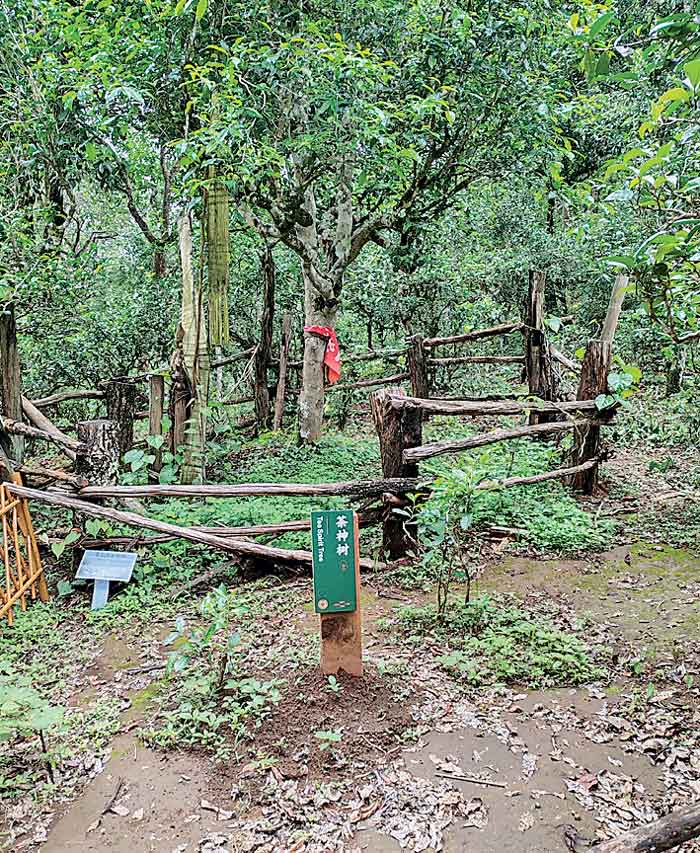
Tea spirit tree at Jingmai tea forest
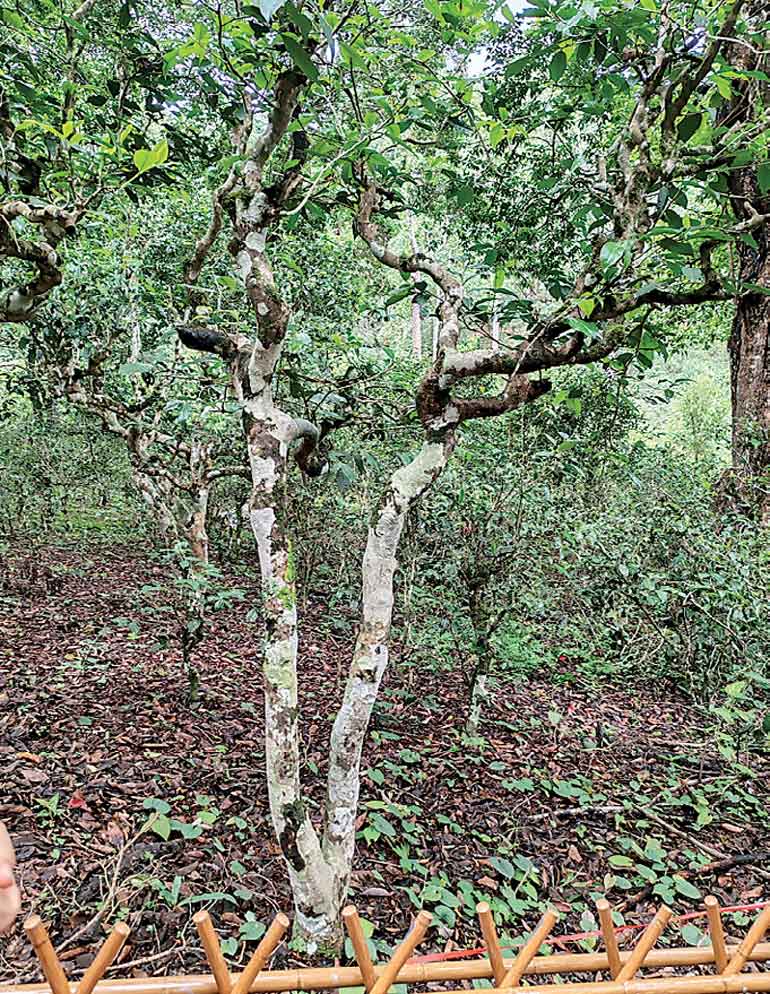
A 200 year old tea tree




