Wednesday Sep 16, 2026
Wednesday Sep 16, 2026
Thursday, 11 June 2026 00:00 - - {{hitsCtrl.values.hits}}
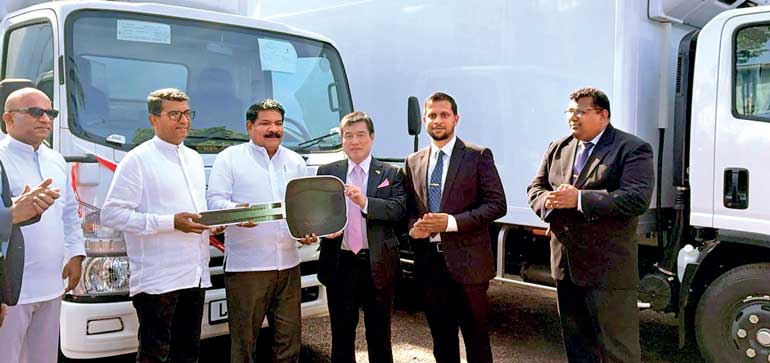
Japan has provided six refrigerated trucks to Sri Lanka’s fisheries sector as part of a ¥200 million (approximately $ 1.25 million) grant assistance program aimed at strengthening the country’s cold chain infrastructure, according to the Embassy of Japan in Sri Lanka.
The vehicles were formally handed over yesterday by Ambassador of Japan to Sri Lanka Akio Isomata to Ceylon Fisheries Corporation (CFC) Chairman Mohammad Nowras Nasar in the presence of Fisheries, Aquatic and Ocean Resources Minister Ramalingam Chandrasekar and Deputy Minister Ratna Gamage.
The assistance forms part of Japan’s Economic and Social Development Programme and also includes the provision of three ice-making machines for Jaffna, Mullaitivu and Trincomalee.
The Embassy said the project is intended to address longstanding challenges in transporting fish and marine products from the Northern and Eastern Provinces to Colombo, a distance of around 300-400 kilometres, where inadequate temperature control has contributed to significant post-harvest losses and deterioration in product quality.
According to the Embassy, post-harvest losses in Sri Lanka’s fisheries sector are estimated to be as high as 40%.
The six refrigerated trucks will be operated by the CFC to transport marine products from the Northern and Eastern Provinces to Colombo, with the project expected to reduce losses, preserve quality and improve the efficiency of fisheries distribution networks.
Speaking at the handover ceremony, Ambassador Isomata said strengthening the cold chain was critical to protecting fishermen’s livelihoods, ensuring food safety and maintaining consumer confidence.
“A cold chain is not merely a technology or logistics system for cooling fish; it is the vital foundation that protects the hard work of fishermen, secures the trust of consumers, and supports national food security,” he said.
The Ambassador noted that reducing post-harvest losses had become increasingly important amid concerns over rising food and fuel prices linked to developments in the Middle East and expressed hope that the initiative would encourage further private sector investment in cold chain infrastructure.
Minister Chandrasekar described the donation as a significant milestone in efforts to modernise Sri Lanka’s fisheries sector and improve distribution capabilities across the island.
The Embassy said the Government of Japan expects the equipment to contribute to the sustainable development of Sri Lanka’s fisheries industry, strengthen food security, improve livelihoods in coastal communities and further deepen longstanding bilateral ties between the two countries.




