Wednesday Sep 16, 2026
Wednesday Sep 16, 2026
Monday, 23 March 2026 03:35 - - {{hitsCtrl.values.hits}}
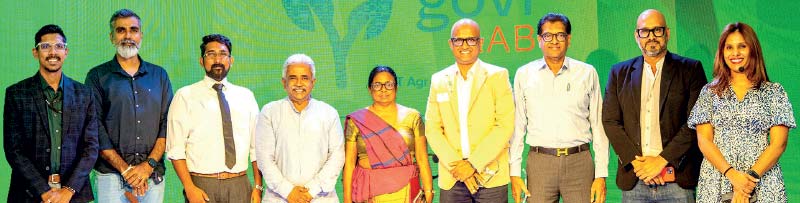
By Dilrukshi Fernando
GoviLab AgriTech Accelerator, a digital initiative aimed at developing and modernising Sri Lanka’s agricultural sector, saw the successful conclusion of its second cohort in partnership with Hatch, an innovation and entrepreneurship platform, the Sarvodaya Shramadana Movement, and the Gates Foundation.
The program focuses specifically on uplifting smallholder farmers by championing technological innovation and scaling up high-potential solutions within the Sri Lankan agricultural sector.
Launched in August 2023 as a key part of the Government’s Inclusive Digital Agriculture Transformation (IDAT) strategy, GoviLab operates as a national accelerator for post-revenue agri and agri-tech businesses, adopting a holistic approach to providing solutions to the business problems it seeks to address. The program provides structured support such as technical expertise, business advisory, market access, ecosystem partnerships, and capacity building for agri-tech startups to scale their solutions to a national level.
Hatch Innovation CEO Mevan Peiris said: “Sri Lanka’s agriculture sector, which engages nearly 30% of the population while contributing less than 8% to the GDP, is in critical need of tech adaptation and efficiency. Through GoviLab, we are providing the national platform necessary to positively disrupt this sector and take it to the future-ready state it needs to be.”
Over the past two years, from 2024 to 2026, the GoviLab AgriTech Accelerator has supported a total of 20 agri-tech startups across two cohorts, closely aligned with national priorities on agricultural productivity, sustainability, digital adoptions, and inclusive economic growth.
Agri-tech as a catalyst for growing the digital economy of Sri Lanka
Information Communication Technology Agency (ICTA) Associate Chief Digital Economy Officer Sachindra Samararatne said: “The key element of doing an accelerator is for startups to go from point A and accelerate to point B. Without that, there is no purpose. So, congratulations to Hatch for all the good work done with all the startups that have emerged through the Govi Lab AgriTech Accelerator.”
In his keynote, Samararatne shared how GoviLab was conceptualised, outlining the macro strategy of the IDAT, and the role played by several organisations, including the ICTA, in its steering committee. “The inception of GoviLab–one of the elements of the IDAT project–was to roll out agri-tech technologies to farmers in Sri Lanka. We had a cohort of agri-tech companies. We wanted to see how these companies can get a foothold in scaling in Sri Lanka and globally. With that intention came the idea to work on a Gates Foundation-funded accelerator for Sri Lanka,” he said.
In the GoviLab implementation process, Hatch was selected as the best accelerator service provider, while Sarvodaya joined the initiative as an entity that has a vast amount of on-the-ground support and knowledge of the farmer bases of Sri Lanka. The vision of the GoviLab program was to work closely with the Government, Agriculture Ministry, and its affiliated departments and ecosystem, while giving focused support to smallholder farmers in the country.
According to Samararatne, Sri Lanka’s agricultural sector presents a strong landscape for the growth of agri-tech, with around 1.3 million paddy farmers alongside producers of several other crops providing a sizable base for the adoption and integration of technology.
He noted that this potential becomes even more significant in light of the Government’s target to expand the digital economy fivefold – from $ 3.5 billion to $ 15 billion – and grow the technology industry from $ 1.6 billion to $ 5 billion by 2030. In this context, agri-tech enterprises have the capacity to make a meaningful contribution to national GDP while also generating valuable export earnings for the country.
Another game changer for the agri-tech space will be the Digital Public Infrastructure, according to Samararatne, who referenced the Crop Resources, Optimising Operations through Precise Information eXchange System (CROPIX), a national digital platform launched in Sri Lanka in early 2026 to serve as a single source of truth for agricultural intelligence and sectoral coordination. The initiative is supported by the Food and Agriculture Organisation (FAO) and the Gates Foundation, linked to the IDAT, with over 150 Application Programing Interfaces (APIs) with which Hatch will work alongside the existing cohorts of GoviLab to expand and access valuable data.
“Today, with technology being much more prevalent, startups being a more mainstream idea, it won’t take long for agri-tech startups to hit the global stage, as some of the startups in the GoviLab cohort have already done, and are being invested in by global venture capital firms. That’s the dream we have for each company,” concluded Samararatne, on a hopeful note for the agri-tech space.
GoviLab: A bridge between tech companies and the farmer community
Sarvodaya Shramadana Movement President Dr. Vinya Ariyaratne said: “Not only is GoviLab a unique accelerator ecosystem but from Sarvodaya’s perspective, it is, in reality, bringing solutions to the grassroots levels.”
“Unless we have the last mile worked out, and farmers are not benefitted, we will not achieve our objectives. This initiative is not just about scaling businesses; it’s about building a vital bridge between our tech companies and farmer communities,” Dr. Ariyaratne added, describing how technology can empower farmers to modernise and innovate their operations and reduce wastage, while addressing several other business challenges existing in the agricultural sector.
The ultimate objective, however, according to Dr. Ariyaratne, is food security. “It’s not just about production. If we have children who are suffering from malnutrition, we have failed in our objectives. Food security has to be achieved through this well-established, resilient agri-tech startup ecosystem.”
“It’s inspiring to see all stakeholders of the ecosystem coming together to solve problems which we were whiteboarding about three and a half years ago,” said Connect to Care Chairman Chandita Samaranayake, who was part of a team looking to launch a program that is sustainable with lasting impact, which formed the basis and concept for the IDAT, the core of which is data and policy.
“The IDAT is about bringing the data together. We have identified about 170 data sets within the mixture of agriculture, plantations, and fisheries. 170 APIs are now connected, talking to each other. That’s a major milestone we have achieved through CROPIX,” Samaranayake said, adding that, in parallel, through the support of Sarvodaya, datasets are provided to Government agencies, enabling them to make policy decisions.
While attempting to solve the problems of smallholder farmers, Samaranayake and his team identified that innovation and solutions closer to the farmer community were missing components. To bridge that gap, for leapfrogging, the idea of GoviLab was formed as a platform for innovators and entrepreneurs to collaborate with Government entities to provide tangible solutions.
“Stay close to farmer problems, and make data available for the entrepreneurs,” Samaranayake requested as a call to action for the Government, as Sri Lanka continues to innovate in the agri-tech landscape.
GoviLab Cohort Two solution showcase
A total of 10 startups in GoviLab’s second cohort, including four female-led startups, presented their refined solutions to industry stakeholders, partners, and ecosystem leaders at the demo day. The solution showcase was the culmination of the successful journey for each company, while connecting them with vital networks and resources to scale their impact.
The GoviLab cohorts have showcased a range of innovative agri-tech solutions since their inception. Highlights include drone technology for paddy fertiliser application and coconut cultivation management, precision agriculture solutions for greenhouses and open-field cultivation, and locally manufactured agri-machinery.
The startups have also ventured into multiple technologies that better manage the human-wildlife conflict – a persistent problem amongst the farming community in Sri Lanka.
Two agro-tech startups from the GoviLab cohorts shared their success stories with the gathering, marked by learnings, challenges, and solutions, which demonstrated the journey from ideation to a fully-fledged operational level.
The evening concluded with an appreciation of all the mentors of the GoviLab Cohort Two.




