Thursday Oct 15, 2026
Thursday Oct 15, 2026
Wednesday, 14 October 2026 00:06 - - {{hitsCtrl.values.hits}}
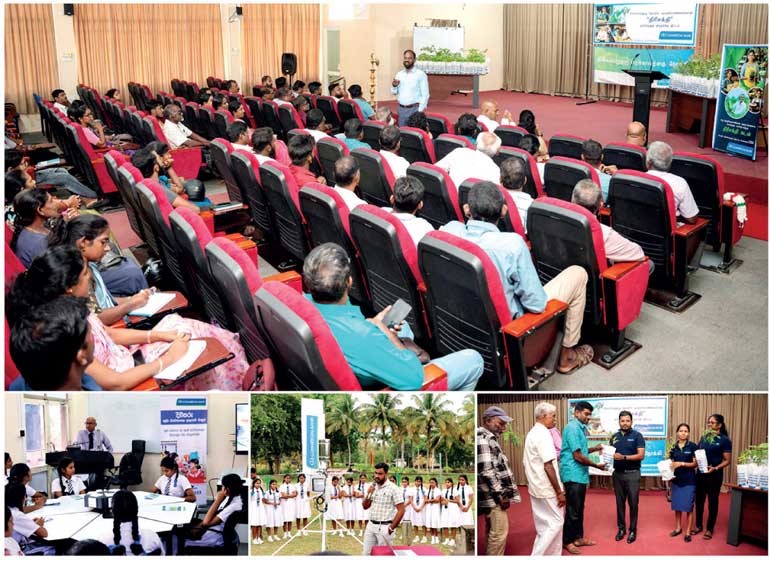
Some of the El Niño awareness programs conducted by the Bank
In response to emerging climate risks, the Commercial Bank of Ceylon has launched a proactive initiative through its Development Credit Department, to equip Sri Lanka’s agricultural sector against the potential impacts of the 2026 El Niño climate pattern.
Seeking to move the industry from reactive loss management to early climate preparedness, the Bank partnered with leading State universities to execute a two-part educational and technological intervention in September 2026.
The initiative comes at a critical juncture. Sri Lanka’s Department of Meteorology reported an 80% probability of El Niño conditions emerging between June and August 2026, with effects expected to persist through November and beyond. As highlighted by the Food and Agriculture Organisation (FAO), El Niño acts as a risk multiplier for rural livelihoods, food production, and water supply.
To mitigate these threats, the Bank’s initiative creates a collaborative network uniting academic institutions, agricultural extension services, technology providers, farming communities, and the financial sector.
The awareness program on El-Niño and its impact on agriculture was supported by 12 Commercial Bank branches, and engaged with over 1,100 farmers at 15 diverse locations, including Vattapalai, Muththajankaddu, Palampas, Oddusuddan, Siyambalanduwa, Lindula, Neluwa, Kalawana, Pannala, Madampe, Mannar, Vavuniya and Kumalamunai.
The series commenced in Kilinochchi at the District Secretariat’s Skill Development Hall. Organised in collaboration with the Bank’s Kilinochchi Branch and the University of Jaffna, the program brought together around 100 participants to focus on climate risk management. Key sessions led by University of Jaffna Dean of the Faculty of Arts Prof. Nagamuthu Piratheeparajah, alongside Department of Agricultural Biology–Head Dr. Suvanthini Terensan, and Inthira Group Managing Director Maheswaran Rajeethan educated local farmers on practical measures to safeguard agricultural yields against climate variability.
The second phase took place at the Faculty of Agriculture, Rajarata University. Led by Faculty Dean Prof. M. H. J. P. Gunaratne, Prof. N. S. Abeysingha, and senior lecturers E. J. Kosgollegedara, and H. G. S. C. Wickramasinsooriya, the session broadened the scope of climate resilience by introducing IoT-based smart weather monitoring. Designed to reach the next generation of agriculturalists, the 100 targeted attendees included 50 youth farmers from local farmer societies, 30 students and school leavers pursuing Agriculture and Bio-system Technology, and 20 Agriculture Instructors from the Department of Agriculture.
These programs were designed as complementary interventions: the Kilinochchi program focused strongly on awareness and agricultural risk management, while the Rajarata program added a practical technology dimension through IoT-based weather monitoring.
Through these workshops, participants were guided on translating localised climate data into actionable farming decisions, including; Strategic Crop and Water Management – adjusting planting schedules, selecting drought-tolerant crop varieties, and adopting efficient irrigation techniques; Soil and Moisture Conservation – implementing soil protection practices to preserve farm investments and maintain yield capacity during periods of heat and water scarcity; and Smart Technology Integration – utilising real-time, IoT-driven weather updates to make data-informed agricultural decisions.
As a key agriculture-supporting financial institution, Commercial Bank said it recognises that climate risks directly threaten farm yields, drive up production costs, and impair the ability of borrowers to meet financial commitments. By bridging the gap between scientific knowledge and financial resources, the Bank enables farming enterprises to integrate risk management into their broader investment planning, offering tailored lending, leasing, and green financial solutions where needed.
This pioneering program stands out for its multi-regional, cross-sectoral approach. By addressing climate vulnerabilities across different agricultural zones, Commercial Bank demonstrates how traditional farming practices, academic research, modern digital tools, and financial backing can be harmonised to build a sustainable and climate-resilient agricultural ecosystem.
The Bank said the initiative also strengthens the connection between research institutions, extension services, technology providers and financial institutions, with the ultimate objective of helping customers move towards more informed, productive, sustainable and climate-resilient agricultural practices.




